Showing posts with label books. Show all posts

Sunday, July 13, 2014

Rereading Laura Ingalls Wilder - as a Birder

I happily read Laura Ingalls Wilder's "Little House" series at least a couple of times as a kid and again as my children got to suitable ages. Recently, having encouraged Dave to read them since he never had, I picked them up again myself.

I find myself reading the story of this sturdy, closely knit pioneer family's travels and travails in the last quarter of the 19th century with new eyes -- the eyes of a birdwatcher, aspiring naturalist and conservationist who newly understands the role that grasslands have played in the North American circle of life and the sad fact that we have been plowing up more and more of them -- starting in the very times of which she wrote -- until native grasslands are almost gone from huge areas of the U.S. landscape.

Though Wilder, with the help of her daughter Rose Wilder Lane, wrote these books decades after the times she describes, they are as close to a contemporary eyewitness perspective on the pioneer experience in those places and times as we have in our popular literature. While the focus of the stories is on family life, she captures a wonderful amount of detail of the world they inhabited.

1939 edition of By the Shores of Silver Lake,
illustrations by Helen Sewell and Mildred Boyle
Photo credit: Bramblewood Fashion blog


Here is one passage, so evocative of the land and its wealth of bird life. Imagine yourself in Dakota Territory in about 1880, newly arrived in a railroad shanty town where your father has taken a temporary job as shopkeeper while your family looks for an ideal homesteading site. Almost 13 years old, you are exploring the lakeshore with your sisters on a summer afternoon:
Laura and Mary and Carrie walked slowly along on the green shore by the rippling silver-blue water, toward the wild Big Slough. The grasses were warm and soft to their feet. The wind blew their flapping skirts tight against their bare legs and ruffled Laura's hair. Mary's sunbonnet and Carrie's were tied firmly under their chins, but Laura swung hers by its strings. Millions of rustling grass-blades made one murmuring sound, and thousands of wild ducks and geese and herons and cranes and pelicans were talking sharply and brassily in the wind.
All those birds were feeding among the grasses of the sloughs. They rose on flapping wings and settled again, crying news to each other and talking among themselves among the grasses, and eating busily of grass roots and tender water plants and little fishes. 
The lake shore went lower and lower toward Big Slough, until really there was no shore. The lake melted into the slough, making small ponds surrounded by the harsh, rank slough grass that stood five and six feet tall. Little ponds glimmered between the grasses and on the water the wild birds were thick.
As Laura and Carrie pushed into the slough grasses, suddenly harsh wings ripped upward and round eyes glittered; the whole air exploded in a noise of squawking, quacking, quonking. Flattening their webbed feet under their tails, ducks and geese sped over the grass-tops and curved down to the next pond. ...
The soft, cool mud sucked around her ankles as she stood, and before her the little ponds glimmered among the tall grasses. She wanted to go on and on, into the slough among the wild birds, but she could not leave Mary and Carrie. So she turned back with them to the hard, higher prairie where waist-high grasses were nodding and bending in the wind, and the short, curly buffalo grass grew in patches.
Along the edge of the slough they picked flaming red tiger lilies, and on higher ground they gathered long branching stems of purple buffalo bean pods. Grasshoppers flew up like spray before their feet in the grasses. All kinds of little birds fluttered and flew and twittered balancing in the wind on the tall, bending grass stems, and prairie hens scuttled everywhere. 
A few weeks later, it's autumn:
The weather grew colder and the sky was full of wings and great birds flying. From East to West, from North to South, and as far up into the blue sky as eyes could see, were birds and birds and birds sailing on beating wings.
 At evening down they came endlessly from the sky, sliding down long slopes of air to rest on the water of Silver Lake.
There were great, gray geese. There were smaller, snow-white brant that looked like snow at the water's edge. There were ducks of many kinds, the large mallards with a shimmering of purple and green on their wings, the redheads, the bluebills, the canvasbacks, and teals and many others whose names Pa did not know. There were herons, and pelicans, and cranes. There were little mud-hens, and the small hell-divers [grebes -- I had to look that one up!] that peppered the water thickly with their little black bodies. When a shot cracked, hell-divers up-ended and vanished quicker than winking. They went far down in the water and stayed there a long time.
At sunset the whole large lake was covered with birds speaking in every kind of bird's voice to each other before they went to sleep for a night of rest on their long journey from north to south. The winter was driving them; the winter was coming behind them from the north.
-- By the Shores of Silver Lake, by Laura Ingalls Wilder  (c) 1939, renewed 1967.
Wilder's writing puts you right there -- hearing the sounds of thousands of birds, and feeling the wind against your bare legs and the warm grass and soft mud under your bare feet. I'll leave you with those passages, for now, but I may be back with more. Though the books reflect some historical views on Native Americans by European settlers (held noticeably less by the main character, Laura, than by certain others around her) that can be disturbing from a modern perspective, they are well worth reading at any age.

Western Grebes, North Dakota 2014

Sunday, December 26, 2010

Nice Minnesota Bird Book for Kids

Wild About Minnesota Birds: A Youth's Guide to the Birds of MinnesotaMy 11-year-old son is showing quite an interest in the birds at our feeders -- he'll grab a field guide to figure out what something is, or grab my camera if it's nearby and start taking photos. (He got the shots of the white-breasted nuthatch in my previous post.) I brought him along on the Christmas Bird Count a week ago, and he remained interested all morning and asked to be put in charge of the observation checklist/tally sheet.

So when I saw the book Wild About Minnesota Birds: A Youth's Guide to the Birds of Minnesota while doing my last-minute Christmas shopping in downtown Northfield, I thought it would be a great choice. It's a nice size (about 7.5" x 10"), with a good balance of beautiful photos and engaging descriptions of the birds, habitat and habits. I'm looking forward to dipping into it myself.

This book is available at Present Perfect on Division Street in Northfield, and I'm sure it would also be available at Monkey See Monkey Do.

Thursday, September 9, 2010

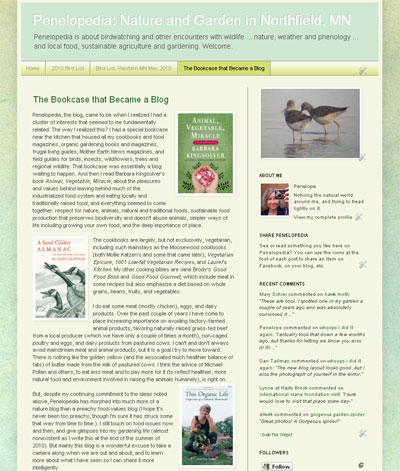
The Bookcase that Became a Blog

To accompany my latest blog redesign, I was moved to write a kind of "About This Blog" page for Penelopedia, called The Bookcase that Became a Blog. You can see it as a new tab at the top of the page.

Tuesday, May 5, 2009

In Honor of Michael Perry's New Book & Appearance in Northfield

About a year and a half ago I wrote about Michael Perry's book Truck: A Love Story and quoted a passage I found particularly intimate and moving. That post can be found here.

Perry will be at the Northfield Arts Guild this evening at 7:30 to read from his new book, Coop: A Year of Poultry, Pigs and Parenting. His visit is sponsored by Monkey See Monkey Read bookstore. I'll be racing back from a choir potluck to attend, and will most certainly be buying a copy of the book. Coop picks up where Truck ends; I can't wait to read it.

Here is Mike talking about the new book.

Saturday, December 27, 2008

New on Penelopedia's Bookshelf... and a yummy snack

This Christmas Dave and I received two beautiful books from my daughters which I am delighted to add to that special bookcase where I keep books about nature, gardening, cooking, and eating locally... the bookcase that, in the end, was really the inspiration for the Penelopedia blog.

I'm not a WCCO listener, but those who are will, I understand, probably be familiar with Jim Gilbert, who hosts a weekly call-in show called Nature Notes. (You can subscribe to podcasts here -- look for Nature Notes about two-thirds of the way down the page -- and I plan to do that.)

Gilbert has taken years of his observations and those shared by his regular contributors and put together a substantial and beautifully illustrated paperback guide to Minnesota phenology called Jim Gilbert's Minnesota Nature Notes: what to look for, week by week throughout the year, with respect to birds, animals, flowers, foliage, crops, precipitation, temperatures, ice-out dates on the lakes, and much more. I love the little downward-tilting nuthatch perching on the "M" of Minnesota on the cover. I look forward to reading this book straight through and then returning to it again and again for reminders of what can be observed around us if we just take the time to notice.

The Farm to Table Cookbook: The Art of Eating Locally, by Ivy Manning, is a gorgeous hardcover that would look wonderful sitting on a coffee table. Organized seasonally, the book is intended to help those who buy what is fresh and in season and are looking for new and delicious ways to serve those early spring greens, wild mushrooms, orchard fruits or winter squash. As a winter meal, how about Twice Baked Irish Potatoes with Stout [as in Guinness] Onions & Kale?

Yet another treat on Christmas day was a snack I bought on a whim at Just Food co-op during its recent anniversary open house: Sing Buri Cashews with dried pineapple, peanuts, lemongrass and Chinese chili, from Sahale Snacks. To tell the truth, I had just about OD'd on nuts this holiday season, and my waistline shows it, but these brought a tangy, zingy, sweet, chewy new quality to rich but heart-healthy nuts, and the pouch is not so big that anyone will go too far overboard on them. Definitely recommended.

Tuesday, August 26, 2008

Books as Souvenirs

While on vacation on the North Shore in early August, I indulged in a couple of books as souvenirs -- a practice I enjoy because a book after all can become a valued member of the family, whereas a knickknack is just ... a knickknack.

In a little bookshop, Drury Lane Books, in Grand Marais, I discovered a series of books by Helen Hoover about life deep in the north woods in the 1950s and '60s. A Place in the Woods tells the story of how she and her husband, both working professionals in Chicago, chose to leave their city lives and move to a primitive log cabin (suitable, if challenging, for winter) and nearby larger summer home in a stand of old-growth forest in northern Minnesota, near a lake within view of Canada. In this book, Hoover writes exquisitely about the forest fauna and flora, and she devotes considerably more detail to these subjects in other books in the series (all recently reissued by the University of Minnesota press as part of the Fesler-Lampert Minnesota Heritage Book series), including The Long-Shadowed Forest, The Gift of the Deer, and The Years of the Forest. I ordered these last three upon my return from vacation, remembering that I had an unused Amazon gift certificate left over from my birthday, and I am now enjoying The Long-Shadowed Forest. All of the books are charmingly illustrated by Adrian ("Ade" as she calls him) Hoover, Helen's husband.

Inspired by the Hoovers' back-to-the-land story, I also ordered the new second edition of We Took to the Woods, by Louise Dickinson Rich. First published in 1942 and described as a perennial bestseller, this tells a somewhat similar tale set a couple of decades earlier in the woods of Maine rather than Minnesota. Rich's book is less focused than Hoover's on detailed descriptions of wildlife, but is told with an engaging dry wit that no doubt accounts for its longstanding popularity.

The other book I bought on vacation I picked up at Northern Lights Gifts and Books near the Duluth waterfront: Serving Up the Harvest: Celebrating the goodness of fresh vegetables, by Andrea Chesman. I have plenty of cookbooks that I don't use nearly as often as I should, but I was drawn to this 500-page paperback volume by its beautiful cover and its big, friendly pages that fall open nicely. The recipes are arranged in seasonal order, taking the reader/cook from asparagus, peas and spinach through the gardening year to winter squash and pumpkins. The author also includes some notes on planting, growing and harvesting the vegetables covered in the book. I've yet to try anything from it, but a summer vegetable bread pudding and a pasta with fresh tomatoes and wilted greens both sound very appealing. I'll keep you posted.

Tuesday, April 29, 2008

Treasures from the Book Raid

The Great Northfield Book Raid is the big annual fund raiser for the Northfield Hospital Auxiliary, and a Northfield tradition. Dave and I went on Friday evening after work. He was eager to see what might turn up at a used book sale in such a bookish town, and we were both happy with what we found. He found some history and Russian literature he was very pleased with; I spent most of my time at the Nature table and came away with half a box of nice paperbacks, mostly, for about $13 (it was half-price night). Here are some of the ones I'm particularly pleased to add to my shelves:
  • The Lives of a Cell: Notes of a Biology Watcher, Lewis Thomas -- I read several of Thomas's books when I was in college (my boyfriend at the time, who is now a physician, professor and medical researcher at U.Penn., introduced me to him), and I'm delighted to own (or own again? I feel I must have had it at one time) this familiar, slim volume of humane essays about science.

  • Botany -- A little (about 4"x6") Golden Press field guide to botany that could come in handy as I think and blog about plants. It's not a guide to identification as much as a guide to the different classes of plants and their anatomy, habits and environments.

  • Dancing on the Shore: A Celebration of Life at Annapolis Basin, Harold Horwood -- a chronicle of life at a haven for wildlife in Novia Scotia. I've not heard of the author before, but the blurb on the inside cover says that this book puts him squarely in the ranks of Farley Mowat and Barry Lopez as "one of North America's most eloquent writers about the natural world." I've read some Lopez, and have at least seen the film about Mowat's study of wolves (Never Cry Wolf). For what that's worth.

  • Speak to the Earth: Pages from a farmwife's journal, Rachel Peden -- A nicely designed little hardcover "book of rural virtues and a naturalist's philosophy" by an Indiana farmwife and newspaper columnist, with a nice sepia drawing of a possum, a blue jay (I think -- it's a little hard to tell in sepia) and a farm field on the cover.

  • Blooming: A Small-town Girlhood, Susan Allen Toth -- Mary Schier introduced me to Toth a number of years back and I've read several of her books about traveling in England. This chronicle of growing up in Ames, Iowa, in the 1950s sounds like something I'll enjoy.
I was also happy to pick up a new copy of Bridget Jones's Diary to replace the one that my elder daughter seems to have adopted for her own, as well as some slightly battered mysteries by Dick Francis, Amanda Cross and Sue Grafton (I discovered I'd never read O is for Outlaw! That will never do...), and some nice clean copies of respectable novels by Annie Proulx, Anne Tyler and Kaye Gibbons. If we get another snowstorm, I'm set. No need to leave the house for weeks!

Sunday, September 9, 2007

Having Fun with Library Thing

Thanks to a link from Rob Hardy's excellent blog, Rough Draft, I've discovered Library Thing. It's a highly addictive web-based service that lets you quickly select and enter books that you own, often in the exact edition you own, and often with cover art. From there you can rate, tag and review your books, find others who share your literary tastes, and create fun blog widgets (see my sidebar, near the bottom of the page, which generates a random list of four books at a time from my library).
I've been startled to discover just how many editions there are of many books -- sometimes dozens. Sometimes I've been able to find mine and sometimes not; you can upload your own cover image and I've done that in a few cases. The default search engines are Amazon and the Library of Congress, but you can access many others, like university libraries, for specialized titles.

Many of my books are in boxes these days, and I'm not going to begin to try to list all the paperback mysteries I own. The books I've entered so far are among my favorites, which is why they are out and accessible, and also why I've rated almost all of them highly.

It occurs to me that I've been building up to this blog for a long time in how I've organized my books. For the past six years, at least, I've had a special bookcase that holds all my books on gardening, cooking, birds, other nature guides, and most of my memoirs (I particularly collect travel and gardening memoir). I've slowly realized that that is the place of honor for any new book of mine.

Anyway, many of those favorite books, and quite a few more, are now in my catalog at Library Thing.

Saturday, September 8, 2007

Quote of the Week: From Michael Perry's "Truck"

One of the best books I've read this year is Michael Perry's Truck: A Love Story, described in a cover blurb from USA Today as "a delightful, quirky account of a year in a mid-American life spent restoring a 1951 International Harvester, cultivating a garden, and falling in love." Perry lives in New Auburn, Wisconsin, and, after years of writing for magazines (some of his articles and essays -- which I'd call a mixed bunch -- have been collected in volumes such as Big Rigs, Elvis & the Grand Dragon Wayne and Off Main Street), he made a decent splash in 2002 with his book Population 485: Meeting Your Neighbors One Siren at a Time, which I also loved. I like Perry best when he loses the verbal attitude that was probably a requirement for some of the magazine pieces, and writes compellingly -- sometimes hilariously, often with a sense of the sacred -- about small-town life.

My quote of the week comes from a passage in which Perry gathers herbs and green onions from his struggling garden, chops them with lots of garlic, mixes in olive oil, red wine, and lime or lemon juice, and after letting the mixture sit at room temperate until lunchtime adds fresh-ground black pepper and grated parmesan. He calls this bruschetta, but serves it stirred into angel-hair pasta, rather than atop the traditional grilled or toasted slices of crusty bread, so perhaps we might consider it more a mixed-herb pesto. An edited version of the rest of this passage appears in my sidebar; here's a slightly fuller version:
I eat in my favorite spot, the big green chair in the living room beside the bookcase with a view through the screen to Main Street. I can't imagine a finer moment than to be here in this old chair with this fresh alive food in my lap, all the greenness and the garlic and the sounds of the day easing through the screen on the back of a breeze. ... There is something about listening to a day through a screen that infuses the moment, as if the steel mesh slows the day down, lets us bathe in it a bit more. A screen seems to filter the harshness from the outside noises and they reach your ear softened. It will be best if the sound is coming to you over a varnished wooden floor decorated with a strip of sunlight; the flat surface, however artificially imposed, is reassuring in the face of entropy and has the added advantage of being made from trees and blessed by light. It is exquisite to sit here in this perfect moment, eating food that I -- a black-thumb gardener -- have coaxed from seed to fork. I am humbled that in the face of all chaos, I should have this plain, priceless moment.