Monday, May 28, 2012

Bluebird Trail, Week 8-9 - Tree Swallows & House Wrens

This week's update covers the last two weeks. We checked the Trail 1 boxes during a very light drizzle on May 20, which we found was good weather for catching birds on their nests. Dave saw three tree swallows on nests that day while I, still in the early days of recuperating after eye surgery on the 17th, rested in the car and just took notes. We weren't able to get to Trail 2 last week. This week I was feeling much stronger, and we visited both trails on the morning of May 27, which was a hot day with temperatures already well into the 80s.

Most of the nestbox activity right now is from the tree swallows, as most of our bluebirds have fledged their first broods and are working on their second nests and eggs.

Tree swallow in nestbox incubating eggs

This is my favorite photo of the week -- a female tree swallow who stayed on her nest when we checked this nestbox on Trail 2. The light was right to catch her beautiful coloring contrasting with the cloud of white feathers. We quietly and carefully put the box back.

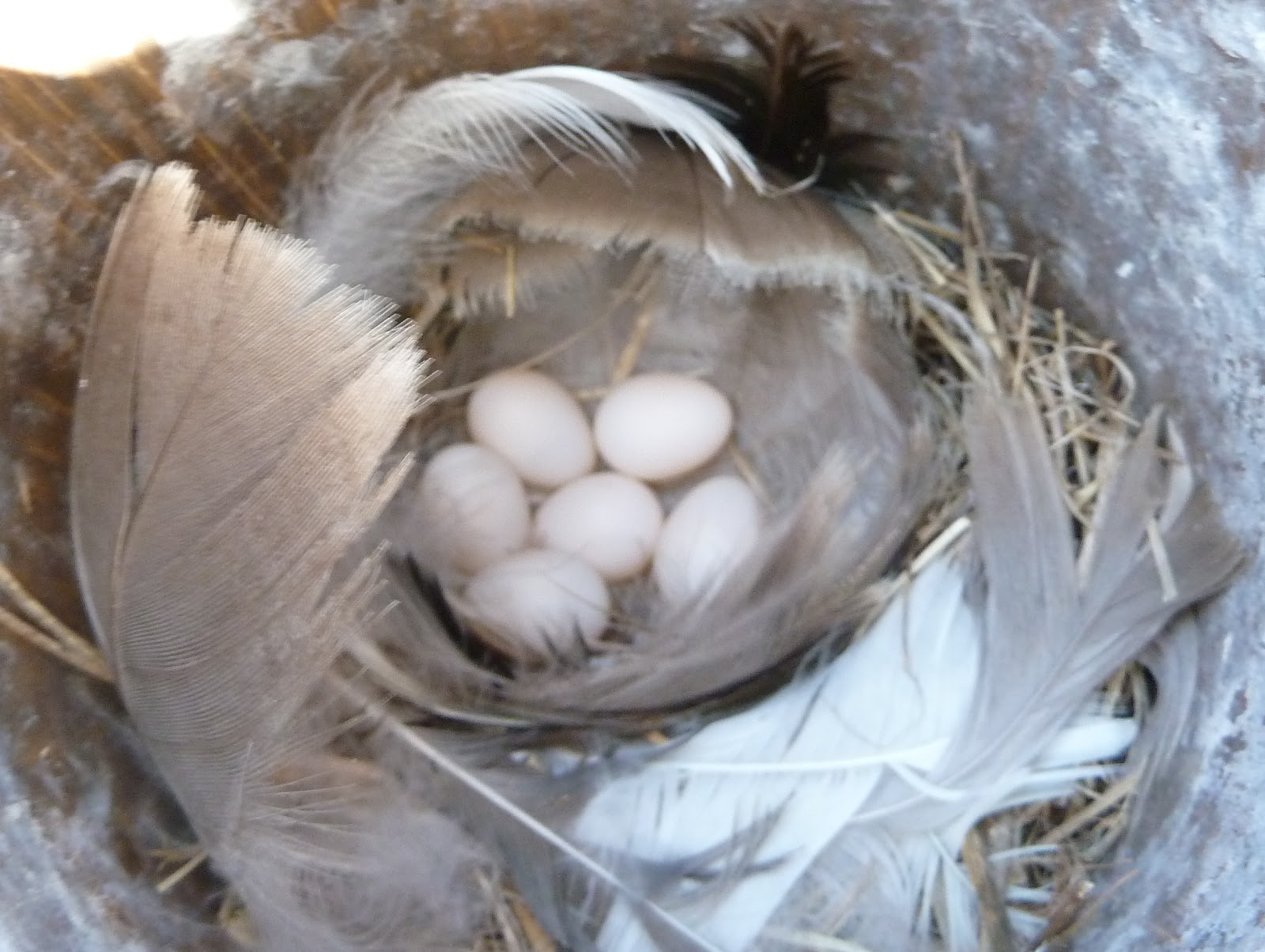
Tree swallow eggs in nestbox

Here is another tree swallow nest with eggs, from one of the boxes on Trail 1. I can't get over how beautiful and comfortable-looking the tree swallow nests are, with all the feathers they use to line the nest. I try to imagine being a little naked nestling, and I would much rather be in a tree swallow nest than a bluebird nest, which is generally just dried grasses with no downy lining. However, I understand that bluebirds are more fastidious about removing the nestlings' fecal sacs from the nestbox, so from that perspective I guess I'd rather be a bluebird nestling.

Tree swallow atop sparrow spooker above nestbox

In the last couple of weeks we were excited to have a pair of tree swallows building a nest in one of the nestboxes at our house, where we've had a hard time getting any successful nests going. We set up the spotting scope in our living room so we could keep tabs on  the activity there. Above, a tree swallow perches atop a "sparrow spooker" that dangles orange construction ribbons over the top of the nestbox; this is thought to discourage house sparrows. The tree swallows found it to be a handy perch. Below, before we saw a house sparrow enter the box which led us to put up the sparrow spooker, the female is looking out of the nestbox while her mate watches from above. 

Tree swallows at nestbox

We have continued to be plagued with house sparrows at this location, but we have also been hearing house wrens quite a bit lately, and it was a house wren that eventually cleaned the tree swallow nest out and drove the pair away. From what we hear, this is typical wren territorial behavior -- they clean out other birds' nests and leave the box so pristine it's as if it was vacuumed out. House wrens will sometimes destroy other birds' eggs, as well. Because of this consistent difficulty with both house sparrows and house wrens, we decided to take down the two boxes at our house. Although they offer some good bluebird habitat, they are just too close to the house (encouraging house sparrows) and some large trees (encouraging wrens).  We loved watching the tree swallows from our living room, and for a couple of days we saw bluebirds at the other box as well, which was a real thrill, but the wrens cleaned that box out too. We feel it's not safe for the bluebirds, tree swallows and/or chickadees at this location, so we thought it was better to take these boxes down.

Tree swallow nestlings, approx. day 2

Above is the first set of tree swallow nestlings we've had. There are appear to be six nestlings that I am guessing are about two days old, based on our records of when the eggs were laid and this guide to tree swallow nestling development at the Tree Swallow Projects site. They are quite similar to bluebird nestlings at this age, but less hairy. The female was in the box when we approached but flew out, allowing us to quickly confirm that the nestlings had hatched. We left as quickly as we could so she could get back to the babies.

House wren eggs

House wrens, unlike the nonnative house sparrow, are federally protected native birds. Once they have an active nest -- not just twigs in a nestbox, but a nest cup and/or eggs -- it is illegal to disturb or remove the nest. Sialis.org, the excellent bluebird site, has a good page about managing house wrens. The All About Birds site has useful breeding information: they lay 3-9 eggs, incubate them for 9-16 days and nestlings fledge in 15-17 days. We now have two active house wren nests on Trail 1, both in nestboxes that had seen very little activity all spring until the last week or two, when the wrens (which typically don't arrive in this area until May) got busy.

The full trail report follows. We have, to the best of our knowledge, fledged 30 bluebirds and have 5 new eggs this week. One nest of 3 eggs (box 18) seems to have failed, but as far as we can tell we had full success of all bluebird eggs in the other nests, as we saw no unhatched eggs or dead nestlings. We have 6 tree swallow nestlings and 5 more nests with tree swallow eggs. We have 2 house wren nests with eggs.

Follow our full bluebird trail adventures here.

Trail 1:

  1. After several days of tree swallow activity, a house wren cleaned out the nest and we had also seen a house sparrow enter the nestbox, so we have reluctantly taken this box down.
  2. (Paired with #1) After recent chickadee activity that didn't develop into a nest, a bluebird pair was seen at this box so we removed the guard that made the hole smaller for chickadeees. A house wren cleaned out the bluebirds' nesting material. We have now taken this box down.
  3. There were two house wren eggs here on May 20 and 7 house wren eggs on May 27. 
  4. (Paired with #3) Tree swallow nest with 5 eggs. Female was on nest May 20 and flew from the nest May 27. Probably now 8-10 days into incubation; we should see nestlings next week.
  5. 5 bluebirds fledged, probably close to a week ago (we observed an adult on top of the box on May 20 and knew they were close to fledging so we did not check the box that day). House wren twigs in box on May 27; we cleaned out the nestbox.
  6. (Paired with #5) Tree swallow nest -- did not check on May 20; 6 eggs on May 27.
  7. House wren nest with 7 eggs. This box had one egg on May 12 and 7 eggs on May 20. Assuming they lay an egg a day, these eggs are now about 10 days into incubation and may hatch at any time now.
  8. (Paired with #7) Tree swallow nest with no eggs on May 20 and 2 eggs on May 27.
  9. We cleaned this box out two weeks ago after fledging our first set of bluebirds. On May 20 there was a full new nest and on May 27 there were 5 bluebird eggs.
  10. (Paired with #9) On May 20 we removed the unused duplicate bluebird nest that had been there all along. On May 27 the box remained empty.
  11. Discontinued  
  12. Discontinued
  13. 5 bluebirds fledged, probably early last week. We did not check the box on the 20th, which was approx. day 13 since hatching. We cleaned out the empty nestbox on May 27.
  14. 5 bluebirds fledged between May 12 and May 20, when we cleaned out the empty nestbox. On May 27 there was a full new nest.
  15. 6 tree swallow nestlings, approximately day 2 on May 27. There were 6 eggs on May 12 and female remained on nest during check on May 20 so we could not count the eggs again. There might be a 7th, but photo (above) appears to show 6 nestlings.
  16. 5 bluebirds fledged close to May 12. We cleaned out the box on May 20. On May 27 there was a full new nest.
  17. This box earlier showed signs of a chickadee nest, but was emptied probably by house wren between May 5 and May 9 and still remains empty.
  18. (Paired with #17) Three pale pink bluebird eggs, cool. These eggs are well past the age when they should have hatched with consistent incubation (2 eggs were noted April 25 and there have been three eggs thereafter). Parents were always previously nearby and vigilant but were not observed on May 27.
  19. Tree swallow nest with approx 7 eggs.
  20. (Paired with #19) Complete bluebird nest with female present.
Trail 2:
  1. Nest with no eggs -- no change.
  2. (I previously reversed the description of #2 and 3 contents.) Tree swallow nest; 1 or 2 eggs on May 13; not checked May 20; female remained on nest May 27 so we could not count eggs. Assuming a clutch size of 6 or 7, incubation is probably 9-10 days along and we should see nestlings next week.
  3. (Paired with #2)  5 bluebird nestlings approx. day 5 on May 27 based on appearance and incubation history.
  4. 5 bluebirds fledged between May 13 (day 10 or 11) and May 20. We planned to clean out the nestbox on May 27, but it appeared that new nest material has been built over the old nest so we did not disturb it. Tree swallow was present on top of the box and there was a large white feather in the nest, so this may have become a tree swallow nest.


Sunday, May 27, 2012

May Birding Notes on Patch

Female ruby-throated hummingbird

My monthly Northfield Patch blog post, May Birding Notes, is now live. This month's edition discusses hummingbirds, orioles, bluebirds, sparrows, swallows, tanagers, warblers, hawks and vultures. May 6 was our first day this year to see both hummingbirds and orioles, and on May 12 I saw my first-ever orchard oriole in a large oak in the Carleton Arboretum.

Here's a preview:
Most of the spring bird migration has occurred, with a big last push expected this coming week. Our summer avian residents are now here. Here are some recent birding observations in and around Northfield:

Hummingbirds: We put out our hummingbird feeder at the beginning of the month, and I first noticed a hummingbird on May 6. Lately we have been seeing females numerous times a day, but sometimes also a male. The ruby-throated hummingbird is the only hummingbird to be expected in this part of the country. If you see one with a pale throat, it is the female. The irridescent red throat of the male can sometimes look purple or black, depending on the light.

Read the rest here.

Tuesday, May 22, 2012

The King of Orange - Baltimore Oriole at Feeder

I've had plenty of opportunity to observe our feeders the last few days while at home recuperating from minor surgery. I've been hoping to capture a male oriole at the oriole feeder in good light, and finally had the chance this evening. He and his mate have been regular visitors the last couple of weeks, but they don't stay long and are quick to depart if they sense motion nearby, so it's not easy to get a photo set up. This time he hung around for just long enough. By the time I pressed the shutter again, he was gone.

Baltimore oriole (male) at feeder

He gives a long percussive chittering call when he arrives at the feeder, which helps me look up at the right time to see him; I've noticed that blue jays also often announce their arrival. I suppose it is a territorial/possessive statement ("MY feeder. MY grape jelly."), but I appreciate that he announces his presence since I never tire of seeing this beautiful bird, which is just with us for a few months each year.

The songs and calls of the Baltimore oriole are quite varied. You can hear several versions at the All About Birds site. I don't hear the percussive call I've described in any of these samples; it may be the "sharp, repetitive chuck" that is described as an alarm call in the text. None of these samples offers the  song that's on my Audubon bird clock, either -- the one that sounds like "Figaro Figaro Figaro."

We offer both grape jelly and orange halves at this feeder but, although orioles are said to like oranges, the oranges are ignored while the jelly is gobbled down.

Thursday, May 17, 2012

More About Turkey Vultures

Earlier this spring we saw five turkey vultures atop an abandoned barn while checking our bluebird boxes near Northfield (see March 24 blog post). A few weeks later we saw two turkey vultures on the edge of the hayloft of the same barn and wondered if they might be nesting there (see April 27 blog post). Last weekend in the same area we saw nine turkey vultures soaring overhead, quite close to each other, and soon afterwards we passed the barn again and found seven turkey vultures resting on the roof.


I did some more reading about turkey vultures, and learned that they roost in large community groups but tend to forage independently during the day. So my early guess that a group seen together in early spring suggested the previous year's family unit is not necessarily right at all.  But it's interesting to learn that they are communal birds.

The bird on the far right, above, is spreading its wings while resting. This is a common stance for the turkey vulture and is known as the "horaltic pose." The Turkey Vulture Society says:
The stance may serve multiple functions, including warming the body and drying the wings. Research on this pose suggests that turkey vultures spread their wings in the mornings, once the sun's intensity reaches a certain level, to raise their body temperature (which they lower at night by a few degrees as an energy saving mechanism). [see Turkey Vulture Facts page]
This photo was taken at about 4:20 p.m., for what that's worth.

 If you see turkey vultures circling in an area, it does not necessarily mean there is a dead animal nearby. The same site says, "Circling vultures may be gaining altitude for long flights, searching for food, or playing."

I like the idea of such large birds playing.

Sunday, May 13, 2012

Bluebird Trail, Week 7 - Mom on Nest, First Fledging & Tree Swallow Eggs


Mama bluebird on her nest


While we were checking Trail 2 today,  a female stayed on her eggs when we opened one of the boxes. We have had a bird fly from a box as we've opened it before, but this was the first time one has stayed. It was quite a magical moment. We weren't able to ascertain how many eggs she's sitting on -- last week there were two eggs in this nest, so if she has the typical clutch of five, she's probably been incubating them for about four days and they'll hatch in another 8 to 10 days.

Trail 2 Box 4 nestlings at about 10-11 days

The nestlings are already quite advanced in the other Trail 2 box that has bluebirds in it (see photo above). We didn't know just when they hatched, but we estimate them to be at 10 or 11 days today, as shown in the photo above. This is the first photo we have that shows a nestling with an eye open. You can see they are becoming quite well covered with feathers.


Our very first nestlings, those in Box 9, have fledged. They were due to do so this past week, and on Saturday we found the box empty and the nest flattened out to accommodate the nestlings as they grew. You can see from the dark edges of the nest in the photo below that the nest was quite wet underneath. There was a lot of rain last week, and that box's opening faces south, exposing it to the prevailing direction of many of our rainstorms. Fortunately, as far as we can tell, the nestlings' health was not compromised. We cleaned out the box after taking this photo so that it is available for another nest. From what we've read, building the nest is an integral part of the reproductive urge, so it doesn't help to leave an old nest in place -- and starting fresh is more sanitary.

Flattened nest left after bluebird nestlings fledged

Nestlings are also very close to fledging in Box 16, if they have not already done so, and the Box 14 nestlings are due to fledge in the next few days.


Tree swallow nest with eggs in Box 15

We were very excited to find six eggs in our Box 15 tree swallow nest yesterday. We love seeing these feathery nests. We several times noticed tree swallows at Box 1 on our property today, as well -- one of the pair of boxes that have remained mainly empty but suffered the early chickadee loss to a house sparrow. And there is a bit of new moss in the other box, so we're hoping a chickadee is trying again. Still, we can sometimes hear a house sparrow nearby, so that threat remains.

Last week I did an abbreviated recap of our trail results. It's helpful to me to keep more detailed notes here, however, so those appear in the list below. Our Trail 1 totals so far: 25 nestlings5 fledged, 10 more are close to fledging, 5 more will probably fledge toward the end of this week, five more young nestlings, and only one nest still with bluebird eggs in it -- the worrying slow clutch of three pinkish eggs. This week they felt cold. The parents are always close by, but perhaps they just don't have the hang of this incubation business. We also have a nest of six tree swallow eggs. On Trail 2 we have four or five nestlings that should fledge in the week ahead, plus an unknown number of bluebird eggs being incubated in another nest, and one tree swallow egg so far in a third nest.


Trail 1:
  1. Tree swallows observed on the box; box remains empty.
  2. (Paired with #1) New moss this week, so we put the chickadee sleeve back on this box to reduce the entry hole size.
  3. House wren had started to put sticks into nestbox -- removed. 
  4. (Paired with #3) This is now clearly a tree swallow nest with large feathers; no eggs yet.
  5. Five nestlings, 11-12 days old.
  6. (Paired with #5) Tree swallow nest. No eggs.
  7. House wren nest with one egg.
  8. (Paired with #7) Now empty; previously contained a few strands of grass for several weeks. Wrens can clear nests.
  9. Our first clutch to fledge. Nestbox was empty; we cleaned it out.
  10. (Paired with #9) Complete nest, no eggs  - no change.
  11. Discontinued  
  12. Discontinued
  13. Five nestlings approx 5 days old.
  14. Nestlings close to fledging; parents still vigilant on wire when a tree swallow approach the box, so we suspect fledging has not occurred yet.
  15. Tree swallow nest with six eggs.
  16. Nestlings may have fledged or will do so shortly - we did not open the box. We did not open this box last week either, as parents were very protective.
  17. This box contained a substantial bed of moss for two weeks, but was suddenly empty last week -- a sign of possible house wren activity.
  18. (Paired with #17) Three pale pink bluebird eggs, cool. These eggs are past the age when they should have hatched with consistent incubation. Parents are always nearby and vigilant (swooping down at us protectively), but we fear incubation has not been successful.
  19. Tree swallow nest - no eggs.
  20. (Paired with #19) Partial nest.
Trail 2:
  1. Nest with several tiny dark downy feathers.
  2. Bluebird stayed on nest so we could not count eggs. Last week there were two cold eggs, so assuming a total clutch of five, probably four days into incubation.
  3. Tree swallow nest, one egg.
  4. Five nestlings approx. day 10-11.