Sunday, August 19, 2012

Bluebird Trail: End-of-Season Recap

Peterson nestbox left open at end of season

The photo above is not one of the nestboxes we monitor. But I liked the symbolism of it for this end-of-season recap post. We saw several boxes like this one at the St. Olaf College natural lands this morning -- they've been cleaned out at the end of the bluebird breeding season and left open to discourage mice and house sparrows from using them over the winter. (See http://bbrp.org/wp-content/uploads/2012/01/Trail-Guide-Final1.pdf) The boxes we monitor are all of the Gilbertson PVC pipe style, which don't have doors that open.

Here are our final bluebird trail numbers for the year:

Trail 1, Rice County, mostly south of Northfield: 7 pairs and 4 single nestboxes

  • 72 bluebird eggs were laid in 11 nestboxes
  • 57 bluebird eggs hatched
  • 46 bluebird chicks fledged
  • Tree swallows used 5 nestboxes and fledged 32 chicks
  • Chickadees started to use one nestbox but never laid eggs
  • House wrens used 4 nestboxes and fledged 22 chicks

Trail 2, Goodhue County, prairie habitat: 1 pair and 2 single nestboxes (we took on the monitoring of these boxes in late April)

  • 19 bluebird eggs were laid in four boxes
  • 18 bluebirds hatched
  • 18 bluebirds fledged
  • Tree swallows also used two of the boxes and fledged 12 chicks

Male bluebird on top of "sparrow spooker"

We did not successfully raise any birds in the pair of nestboxes we put up this year on our own property. That was where house sparrows killed a chickadee early in the season. In mid-season, we attracted both tree swallows and bluebirds. The tree swallows seemed to be building a nest, but did not lay eggs and eventually disappeared. The bluebirds nested and hatched a clutch of four eggs in a box where we had put up a wren guard, but when they were a few days old, the nestlings vanished from the nest. This was very distressing; we were alerted that something might be wrong when we could see the male calling repeatedly and flying to and from the box, and when we checked the box later that day we found the babies were gone without a trace, but the nest was intact. Our Rice County bluebird mentors said that most likely house wrens, but possibly sparrows, could have removed the chicks. We will see if we can find a better location next year -- one farther from the house and from large trees -- to see if we have better luck. We can't in good conscience keep trying to attract bluebirds, tree swallows or chickadees to locations where there is a recurring pattern of attacks.

Bluebirds raised two broods in quite a few of our boxes this year, but we did not have any bluebirds successfully raise three broods this summer, despite the early spring. The closest we came was in our earliest nesting location. There, we had a clutch of five successfully hatched and fledged by the second week of May. A second clutch of five was hatched in the same box in early June, but all five nestlings perished within a few days of hatching; we found them dead in the box. Soon afterward a new nest was started in the other of the paired nestboxes. Four out of the five eggs hatched and they fledged in late July. Since our theory about the dead nestlings was that their mother had been killed, the final clutch on that site may have involved the same male and a new female, or even a whole new pair, but we can't be sure.

It's been a fascinating season. We've had a lot of pleasure, a lot of learning as we went, some distress and heartache, and much wonderful outdoor time every week as we monitored the boxes. We have felt honored by this precious opportunity to observe the private lives of cavity-nesting songbirds and try to keep them safe. We look forward to next year!

Friday, August 17, 2012

Great Egret

The great egret is a fairly common sight in southern Minnesota from spring through September. We see enough of them that we can take them for granted, but they are simply spectacular birds: pure white, tall, long-necked, long-billed and long-legged, with a wingspan of more than four feet. They can usually be seen at the shallow edges of ponds or in wetlands, where they move slowly or stand very still and stab lightning-fast at fish with their long bills.


Here are two shots of the same bird, seen in western Minnesota in early August, showing how different they look depending on whether they coil or extend their necks.


When they fly, their black legs trail out behind them and they hold their necks deeply coiled, or tucked.

Egrets, herons and the more secretive bitterns are all part of the family Ardeidae. The Sibley Guide notes that the great egret's combination of long yellow bill and black legs is unique among the herons and egrets. 

The snowy egret, whose range overlaps a fair amount with the great egret's but is not often seen in Minnesota, is similar but smaller, with somewhat lacier plumage, black-billed and yellow-footed (they look as if they are wearing yellow rubber gloves). We saw one or two of these in northeastern South Dakota the same weekend we saw the great egret shown here.

Sunday, August 5, 2012

Shorebird Workshop, August 3-5, 2012

Dave and I just got back from the Shorebird Workshop led by Doug Buri and Bob Janssen, based in Milbank, South Dakota but with field trips in both South Dakota and Minnesota. It's three days of just enough classroom time to get some basics, then as much field experience as possible, assisted by these two highly knowledgeable and nice-as-can-be instructors. You can study field marks from a book, but there's nothing like seeing the birds in real settings to improve your identification skills.

Workshop members get up close to the water

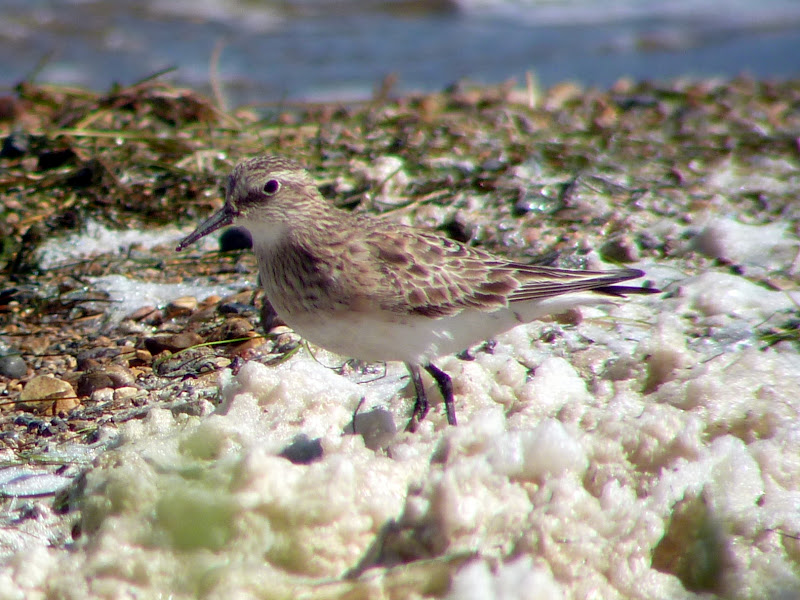
Here was a life bird for me: the Baird's sandpiper, found on the shore of Bitter Lake. I wasn't at all familiar with this bird before this weekend, but I know it now, because its wing primaries (long flight feathers) extend beyond the tail and it has smudgy brown markings on its breast. The other shorebird with wings this long in relation to its tail is the white-rumped sandpiper, which is grayer, rather than brown, and has clear, not smudged, dark streaks on its breast.

Baird's Sandpiper at Bitter Lake

Some shorebirds are very distinctive, but others require some practice to tell them apart. We focused on getting familiar with approximately eight shorebirds that are fairly common in South Dakota and western Minnesota during migration. If you know the common ones, something different will stand out when you do see it.

I loved the South Dakota and western Minnesota landscapes we visited, in picture-perfect weather, especially on Saturday and Sunday after a storm had cleared the air. On a large plateau west of Milbank known as the Coteau des Prairies, where Bitter Lake is, we learned that rising waters in natural basins that have no outlet for their water have overwhelmed farms and homes with no hope for respite. Here's a good article about this phenomenon. 

Bitter Lake near Waubay, SD

Bitter Lake has grown immensely in the past two decades -- from a slough only two feet in depth and 2,000 acres in size, it has grown to a lake of 3,500 acres and is South Dakota's largest natural body of water, according to this article on SiouxCityJournal.com. The article cited in the previous paragraph says it used to be a mile from the town of Waubay, but now it laps at the southern edge of town. We saw Western and Clark's grebes there, as well as egrets, a Caspian tern (a life bird for me), the Baird's sandpiper (see photo above), and a variety of other shorebirds.

Other highlights of the trip included several buff-breasted sandpipers, some marbled godwits, a Wilson's snipe, some dowitchers, and an osprey carrying a fish, seen on our way back from a quick side trip to Thielke Lake a few of us took at the end of the day Saturday.

Please take a look at a slideshow of photos from the weekend (below). I encourage anyone who is interested to sign up for any of Doug and Bob's excellent workshops. Besides the August shorebird workshop, they offer an early-October sparrow workshop and the Fort Pierre birding workshop, covering birds found on the mixed grass prairie and the Missouri River, in May. All come highly recommended, and we hope to attend these in the future.

Saturday, July 28, 2012

Joe-Pye Weed with Bees


Because it's been so hot and humid lately I've not spent much time in the garden. The last couple of days have been much more tolerable, and this afternoon I wandered out with camera in hand to see what I would see.

My main backyard garden bed is a mix of vegetable space and perennial flowers, with a fair amount of weeds and grass in the mix.


Today I noticed that I have several tomato fruits developing, my peppers have pretty, bell-like flowers but no fruits yet, and my cucumber plants have been nibbled badly and are not faring well.

But mostly I noticed the flowers and the bees. On a mass of flowering thyme, tiny bees were in constant motion. Purple coneflowers are flowering in abundance, and the phlox is now in bloom. And on the giant Joe-Pye weed, standing well over five feet tall, there was a bee on almost every flower cluster. I saw one bumble bee, as well.

Joe-Pye weed (genus Eutrochium) is well known as a wonderful attractor for bees, butterflies and moths. It is native to the eastern United States. It's a pity that it has "weed" in its name (as quite a few valuable wildflowers do, including the milkweed so important to our monarch butterflies), as it may sound less appealing to add to gardens, but it's a terrific native plant for this area, supporting our pollinators. This page about gardening to support wildlife in Minnesota has a helpful list of other flowers, shrubs and trees that will encourage our native insects and birds.

I don't know whether any of the bees I saw today were standard European honeybees, whose mysterious declines we have read so much about, or whether they were all native bees. Whichever kinds they were, they were all busy with the vital work of pollination, and I thank them.

Tuesday, July 17, 2012

Five-year Blogiversary for Penelopedia

An earlier header image for Penelopedia

Five years ago today Penelopedia was born, with the inaugural post This Is My Garden. From its initial focus on the local food movement and vegetable gardening to the birds-and-nature blog it tends most often to be these days, this project has led me, more than anything else it has done, to learn about the things that I observe so that I can write about them.

Later header image

The blog has carried me through five pivotal years personally:
  • A stint as a single mother living with my young son in a rented duplex with a patio garden (the subject of that first post)
  • My eldest daughter leaving for college and emerging a beautiful, independent, competent young woman with a passion for art
  • Joining Facebook and greatly expanding the circle of people I feel connected or reconnected to
  • Getting married again and acquiring two cats along with my birdwatching, cat-loving husband, Dave
  • Moving back into my former house with said husband and son
  • My second daughter moving with her Dad to St. Paul so she could attend a performing arts high school there, then eventually graduating and going off to college herself to further develop her musical gifts, which were showing themselves by the time she was two
  • Deciding to adopt a kitten for my son and coming home from the shelter with not one but two young cats, for a crazy total of four, without whom life would be far duller
  • Saying goodbye soon afterward to my dear dog, Jennie
  • My son finishing elementary school, suddenly shooting up and developing a man's voice, and completing a year of middle school (and becoming quite a good birdwatcher along the way).

Current header image

Over the course of 618 blog posts, I have become a more knowledgeable birdwatcher myself, and a somewhat better photographer with my simple point-and-shoot compact camera. I've also made "blog friends" I've never or rarely met in person.

I have had the delight of people occasionally letting me know that they get pleasure from my blog, or learn from it, or both. I generally write without thinking too much of who may read my words or see my images, so it is beautiful to know that they do sometimes land where they are appreciated. Thank you for that.

The main point of this blog is to celebrate that which is all around us but apart from the human routine. Combat nature deficit disorder. Walk in the woods. Hear the dawn chorus. Hear an owl. Observe patterns. Stretch your legs. Put up a bird feeder and see who comes. Breathe clean air. Watch the ever-changing sky and feel the wind on your face. Marvel at the web of the garden spider and the migration of the birds. Smell the sweet meadow and the ozone of the rainstorm. Touch the rough bark and the smooth stone. Walk in the softly falling snow. Blow the dandelion fluff. Taste the ripe berry by the side of the trail.

Notice, and learn, and celebrate, and respect, and tread lightly. That's what I'm trying in my small way to do.