Monday, January 9, 2017

Opossum Tracks


I was intrigued by these tracks in fresh snow on our driveway recently -- they had a hand-like quality, with a hint of a thumb on the side, and the pairs of tracks nestled up against each other in an distinctive pattern. They clearly weren't the usual squirrel or rabbit, and I wondered if they were raccoon. However, after some knowledgeable input from folks in the Minnesota Naturalists Facebook group, I came to the excited conclusion that an opossum was responsible for the tracks. 

I've rarely seen these secretive creatures, and more often seen them dead than alive, but I know they are around here -- in fact, one of my very early blog posts, nine years ago now, was about possums after I sighted one on the main street near my house: read it here

Apparently the range of the Virginia opossum has been expanding northward into the state, whether due to a warming climate or human development patterns, with roads, bridges and culverts making it easier for animals to move around. A Minnesota Public Radio story from 2011 notes that while possum have been known in southern Minnesota for 100 years, their appearance in the Twin Cities metro area and further north is a much more recent phenomenon.

You are welcome here, little buddy. Peace.

Sunday, December 18, 2016

Christmas Bird Count 2016

I was worried about this year's Christmas Bird Count, which was held yesterday in our area (the "Faribault circle"), as the weather forecast was terrible: 6-9 inches of snow were predicted to fall by morning and then the temperature was expected to plummet, along with brisk winds and blowing snow causing more headaches as the day went on.

However, the snowfall wasn't as heavy as predicted; it had stopped by the time it was getting light, and Northfield-area snowplows did an excellent job of getting the roads clear enough for reasonable safety. So my frequent CBC companion Dan Kahl and I set out in his trusty Subaru (with emergency supplies in the back, just in case). Here's what it looked like on 110th Street southeast of town.


Kind of bleak, eh? You might not expect to see much bird life, but in fact we came back with a higher species count than I've recorded here in the past: 25 species (see full list at the bottom of this post).

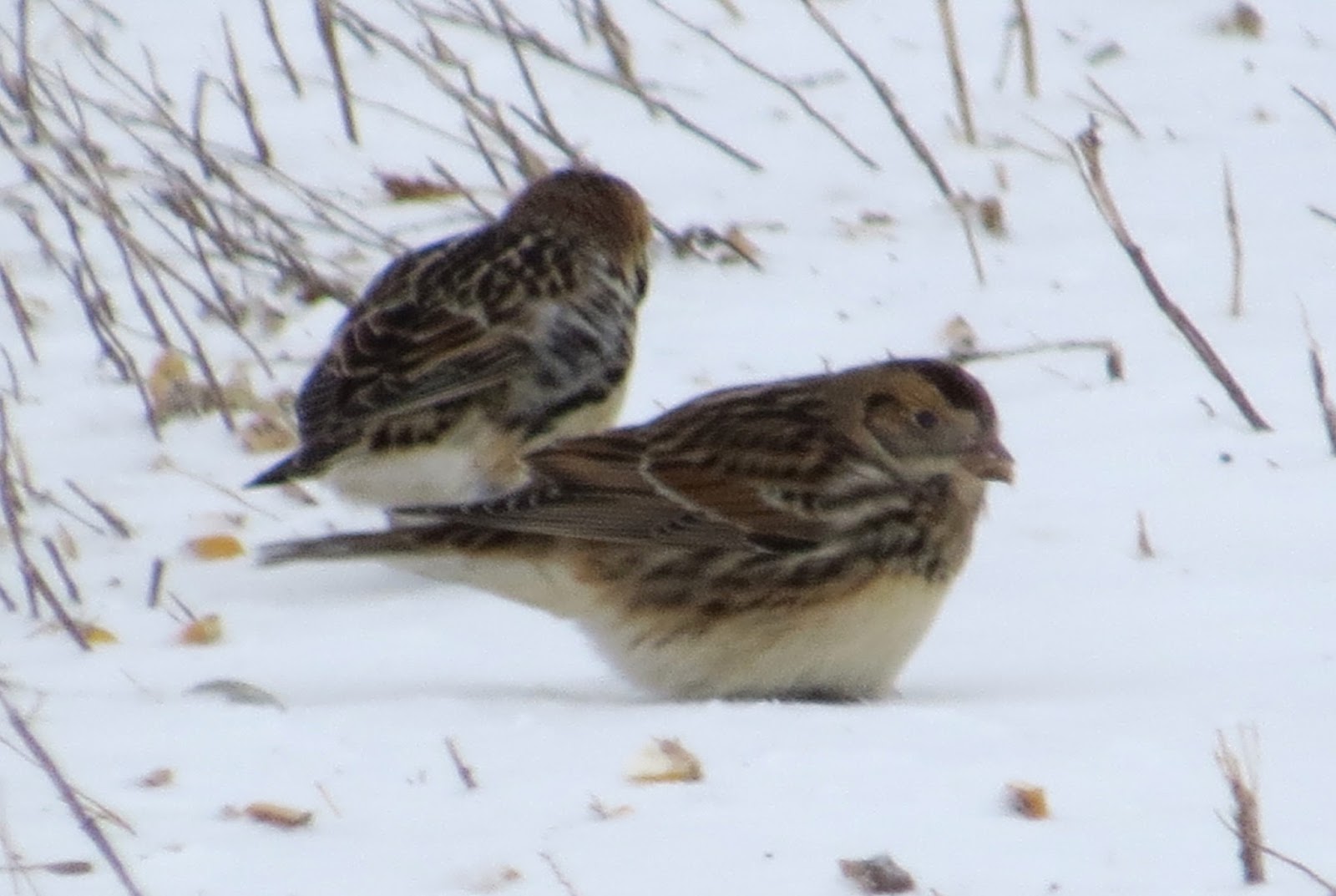
On that very road, we saw two pairs each of three ground-feeding birds that I've not often seen, though they are not uncommon: lapland longspurs, snow buntings, and horned larks. Lapland longspurs and snow buntings breed in the Arctic and are only here in the winter, while horned larks can be found in most of the U.S. year-round. In the photos below you can see some corn kernels that no doubt attracted these seed-eaters to the side of the road.

Lapland Longspurs


Horned Lark

Here's another shot of the rural landscape. I love the patterns of bare hedgerow and grasses against the snow.


Though we had a slow start to winter this year, strong cold in the past week caused ponds and streams to ice up quickly. The large pond south of Superior Drive in Northfield had just a few open areas of water left, and in one of them we saw two Canada geese, a mallard, and two American coots. The coots were a surprise, as they don't generally winter here, but perhaps they were lulled by the extended fall we had until recently.

American Coots (rear and right) with Canada Geese

I was also excited to identify a rough-legged hawk -- another Arctic-breeding bird that winters in southern Canada and much of the U.S. The prominent black patches at the bend of the wings helped identify this rather pale hawk.

Here's our full list for the day:
  • Canada Goose - 19
  • Mallard - 100+ - seen all at once, criss-crossing the sky in many skeins, wings beating fast
  • Rock Pigeon 5
  • Mourning Dove 3
  • Bald Eagle 6  - including a group of 5 circling together, 3 adults and two juveniles
  • Red-tailed Hawk - 1
  • Rough-legged Hawk - 1 
  • Red-bellied Woodpecker - 4
  • Downy Woodpecker - 7
  • Blue Jay - 1
  • American Crow - 14
  • Horned Lark - 2
  • Black-capped Chickadee - 11
  • White-breasted Nuthatch - 4
  • American Robin - 1
  • Cedar Waxwing - 20
  • House Sparrow - 20
  • House Finch - 10 (I wonder if I captured them all -- it might have been a few more)
  • American Goldfinch - 2
  • Lapland Longspur - 2
  • Snow Bunting - 2
  • American Tree Sparrow - 4
  • Dark-eyed Junco 30
  • Northern Cardinal - 6
No starlings, pheasants or turkeys!

Wednesday, March 16, 2016

Mountain Bluebird - Rare in Minnesota

We had seen reports of a way-out-of-its-range male Mountain Bluebird at Schaar's Bluff near Hastings, Minnesota, and were fortunate to be able to get extended good views of it Monday evening after work. What a beauty!


The overcast sky, fading light and rather diffuse color of the bird when seen from the front created some photographic challenges. At one point it flew to a perch within 15 feet of where I was standing, but with a network of high-contrast tree branches in the background, I could not get my camera to focus on the bird. The photos show here were all taken from many yards away with high zoom, and then cropped.


The normal range of the mountain bluebird is primarily the western mountain and plains states and up the western part of Canada into Alaska in the summer breeding season. Winters are spent in the southern part of that range and well south into Mexico. Normally it would not be closer to us than the western edge of the Dakotas.


For comparison, here (below) is the male eastern bluebird, which is the bluebird we normally see in this part of the country.


Sunday, March 6, 2016

Spring Birding Begins! - Ducks and Geese

With temperatures heading high into the 50s today, we headed down to the Wells Lake causeway west of Faribault and saw hundreds of greater white-fronted geese as well as many common mergansers and some redheads and coots (in addition to gulls and oodles of mallards and Canada geese). The large lake has already opened up enough that all of these were hundreds of yards away and a strain to see, even through binoculars and spotting scope, so there may have been other species that we couldn't identify.

In contrast, at the Superior Drive pond in Northfield, which now has a lot of open water as well, we got some lovely views of several lesser scaup, a diving duck that is usually one of the first migrating ducks I've recorded over the past few springs (here are other posts I've written about scaup -- in the exceptionally warm spring of 2012, on March 7 the ice was almost completely out on that pond and I counted 42 scaup). Lesser scaup moving through our area are on their way to summer breeding grounds in the northern plains of Canada after wintering in the southern states, along the Gulf Coast, or maybe in Mexico.

Look at that beautiful blue beak, golden eye, and dark head shining purple in the sun.


Sunday, January 31, 2016

Dark Water in Winter

I'm endlessly fascinated by the relatively rare (in Minnesota) sight of unfrozen water in wintertime. The contrast to the snow on the banks makes the water look so dark and mysterious, and the bare trees are beautiful when reflected. My friend Adele and I went for a walk on Saturday and I captured these scenes.

In the first photo, you may be able to see a group of mallards at the back.


As my friend Adele and I looked down at this next bit of the creek on Saturday, it almost looked like a summertime scene where skimming insects leave constant dimples and ripples on the water -- but this was late January, so insects weren't a possibility. We soon realized that there was very fine drizzle, which we hadn't noticed until then, making the drop marks on the water.


This next one is a crop of the photo above. Click the photo to see the larger version showing the many overlapping ripple marks.


Sunday, January 17, 2016

Watching Birds on Winter's Coldest Morning

It was about -15 F. when I spent some time watching birds at our feeders and in nearby trees this morning. Our coldest days tend to be cloud-free, so the light was good. Since I take many of my feeder photos through my living room window, I do some color correcting afterward to take away the dullness that the window and its glare can impart.


I love female cardinals. This one's red eyebrow is illuminated, matching her beautiful red bill. She's accompanied at the feeder by a goldfinch and, barely visible, a house finch.


This female white-breasted nuthatch caught my eye because, unusually, she was head-up on the trunk of our big maple tree, rather than upside down as one usually sees nuthatches. She's well-fluffed for maximum insulation from the cold.


This male house finch is also doing a puffball imitation to keep warm.


And this bright-eyed chickadee sat in the same position for quite a while. Was he or she miserable in the cold, or doing just fine? Our northern birds seem to handle the cold remarkably well, Here is a good overview from the Cornell Lab of Ornithology of some of the ways birds cope with severe cold, which include not only fluffing up those down feathers but eating as much as possible and sheltering from the wind.

Thursday, December 24, 2015

Peace, Joy, and the Christmas Bird Count


This lovely male house finch, high in a tree above Sibley Swale, was beautifully illuminated during the Christmas Bird Count last Saturday. The morning was cold, cold -- with not much wind, but enough so that walking west made the eyes water and the face go numb.


During the count it helps to put a highly visible notice on one's vehicle explaining why you're driving slowly and peering through binoculars at people's houses (but really, at their bird feeders, trees, shrubs, and lawns).

It was good to once again do the count in the company of Dan Kahl, the caretaker and naturalist at Mount Olivet Retreat Center in Farmington. My husband Dave joined us for part of the morning as well, but unfortunately his one good eye was bothering him and he wasn't seeing well, so he bowed out about halfway through.

Our territory, as usual, covered a rural area east and south of Northfield as well as much of the south side of Northfield itself. We drove most of it but walked a bit of Sibley Swale, the Sibley School nature area, and the marshy area just west of the south end of Archibald Street.

This was our count for the morning -- 20 species, which is two more than last year:
  • 60 house sparrows
  • 40 European starlings
  • 32 American crows
  • 26 dark-eyed juncos
  • 14 blue jays
  • 14 mallards
  • 12 American goldfinches
  • 9 house finches
  • 7 pine siskins
  • 6 downy woodpeckers
  • 5 black-capped chickadees
  • 5 rock pigeons
  • 3 white-breasted nuthatches
  • 2 American tree sparrows
  • 2 mourning doves
  • 2 northern cardinals
  • 1 Canada goose
  • 1 red-tailed hawk
  • 1 ring-necked pheasant
  • 1 red-bellied woodpecker

Gene Bauer always does a meticulous job of organizing our regional Count, and it's so much fun to breakfast with all the other CBCers at Gene and Susan's house and return to report in and warm up over soup at lunchtime. Many thanks to them, as always.

To all: Wishing you peace and joy in this season of darkness and lights, and the restorative and transformative blessings of nature in the year ahead.

Wednesday, December 23, 2015

Ever Seen the Top of a Red-bellied Woodpecker's Head?

The red-bellied woodpecker is always one of my favorite visitors -- so large and beautifully patterned. The dark eye in the pale, unstreaked cheek gives the bird a fresh-faced, approachable look.

This female comes to our feeders quite often these days.


The picture below shows how these birds use their tails for support, bracing themselves against a tree trunk or a bird feeder.


And here, below, is an unusual view -- at least for me. I've included this shot although it's otherwise not a good photograph, because it's interesting to see so clearly the straight line where the red cap meets gray in the female. The male's red cap extends all the way to the beak.

Sunday, December 20, 2015

Ice Forming on a Frigid Morning

Saturday was the Christmas Bird Count in our area, and wouldn't you know it would be the most frigid morning we've had this whole mild December -- only about 10 F. as we set out around 8:00. One bright side was seeing some fascinating ice formations along the creek near Dennison, where we always stop in hopes of seeing birds, but rarely see any even when there is open water. This time we saw a couple of goldfinches. 

Click on any of the photos below to see them larger. They were taken from quite some distance so they are not all crystal clear, but you can see what a variety of patterns and structures were to be seen.


I haven't studied ice formation much, but there is some basic background in this Britannica article

The only ducks we saw all morning were a group of 14 mallards splashing vigorously in a small area of open water in the middle of the pond south of Superior Drive. Man, that looks cold.


Sunday, August 16, 2015

Monarch on the Joe-Pye Weed

It was a sweet sight to observe a monarch butterfly on some pollinator-friendly, native Joe-Pye Weed (Eutrochium) in our garden today -- the first confirmed monarch sighting here in several years. We have quite a few milkweed plants, although they are not growing where there is enough sun for them to produce flowers. These photos were taken through my living room window on an overcast day.


Monday, May 25, 2015

From the Archives: Dandelion Clocks Aglow

This post was originally published June 6, 2008, when my son was eight. I've been noticing again how dandelion seedheads catch the light and have a magical appeal -- if you're open to it!


On a recent evening walk, I found the glow of dandelion seedheads, or "clocks," illuminated by the setting sun, quite magical. My son, like many children, loves to blow the dandelion clocks. Adults, on the other hand, tend to consider dandelion clocks an eyesore and shudder at the thought of those countless seed parachutes wafting over their lawns. I remember my mother teaching my brother and me to "tell the time" by counting the blows it took until the seeds were all blown away. There is still something compelling about those weightless, silky orbs, if we take the time to notice.

Sunday, May 10, 2015

Bluebird in Soft Focus on a Gray Day

I sometimes forget what a difference good light makes to the clarity of a photo. But the flip side of that can be the tender, even painterly, softness to shots taken on an overcast day. Here is a male bluebird perching on a marker post in the Upper Arb at Carleton College, with a stand of leafing-out trees some distance behind.


Sunday, May 3, 2015

2015 Bluebird Trail

Dave and I are a month or so into our fourth year of monitoring blueboxes in the Northfield area. This year, in addition to the two trails we've been covering in previous years (one currently with 12 boxes along rural roads south of Northfield and the other with five boxes near Randolph), we've taken on (at least for this year) another existing trail in the Carleton Arboretum that has 9 pairs of boxes over about a two-mile walking trail.

This trail uses a different type of nestbox than we're used to -- the modified Gilwood rather than the Gilbertson PVC style -- so that's been a learning curve. (See a comparison of box styles.) Both are mounted on conduit poles for good predator deterrence. (Please don't mount bluebird boxes on wooden fence posts and other areas where cats, raccoons, snakes and other predators can easily access a buffet of eggs and nestlings. If you have older-style boxes mounted in that way, you'd be doing a good deed by replacing them with newer pole-mounted boxes. If you're in our area and would like help replacing older boxes, message me and I'll be glad to help make that happen.)

The Gilwood has a front-opening door which is probably less alarming to a bird that happens to be sitting on eggs during a box check than the action of detaching the PVC box from its roof as you do to check inside the Gilbertson boxes. However, Dave and I aren't very tall, and even after lowering most of the boxes we find we need to use a small mirror on a wand (available at auto supply stores) to see the contents of the nests. Photography of box contents would be difficult indeed.

As of this week we have quite a few bluebird eggs, more nests that don't have eggs yet, and also much nesting activity by tree swallows. This morning as we walked the new trail I was able to get some nice photos of both bluebirds and tree swallows -- sometimes in the same shot.

Click any of the photos to see them larger.


Monday, April 6, 2015

Sandhill Cranes, Platte River - with video

For millions of years, cranes have migrated through what is now south central Nebraska on their way to breeding grounds in the north. I was honored to witness the spectacle of sandhill cranes gathering on the Platte River in late March. At sunset the cranes fly in by the thousands from the fields to roost on the river overnight; at dawn they rise in groups both small and large, and disperse to glean grain from the late-winter fields. Some half a million cranes pass through there, in the vicinity of Kearney, Nebraska, from late February to early April each year. The sight and primordial sound of hundreds or thousands of cranes, with the backdrop of some of the most beautiful sunsets and sunrises I have ever seen, will long stay with me. So will the moment when a clamorous group we were watching, at some signal undetectable by us, went completely silent. A few breathless moments passed -- and then they lifted en masse into the sky.


Turn up the volume on the video to hear the cranes.


Saturday, February 14, 2015

Why I'm a Birder: Loving the Places They've Brought Me

I've finally been reading The Big Year by Mark Obmascik. It's the story of three obsessive birders and their race to see the most species in North America in a year. The book inspired the Steve Martin/Jack Black/Owen Wilson film of the same name.

Early in the book the author describes one of the competitors, wealthy businessman Al Levantin, who kicks off his Big Year spotting mountain birds from skis in his home base of Aspen:
"That was the thing with Levantin: he loved the birds, but he really loved the places they brought him. When you spend your career in the confines of a gray suit, the pipits at dawn above timberline are even more wondrous. He lived to be in the field."
That rang so true for me that it practically leapt from the page, shimmering in gold.
~~~ He loved the birds, but he really loved the places they brought him. ~~~
I don't mean exotic new locations, though maybe someday birding will take me to some of those. I mean that my growing interest in birds has gently led me into the natural world, as well as into places that might also be described as states of mind: the wondrousness of the pipits at dawn.

What are some places birding has taken me?

Outdoors.
Woods. Prairie. Trails. Ponds. Riverbanks.

The frozen Missisippi in winter, looking for bald eagles.
The first ice-free pond that hosts migrating ducks in the spring.
The Christmas Bird Count, spent driving slowly along rural roads looking for every single bird we can spot.

Barely leafed-out woods in May, looking and listening for warblers.
A driving trip up the Northern California coast: oystercatchers and thousands of marbled godwits.
A hilly hike in a Bay Area wilderness area, in search of golden eagles.
Sewage ponds. Yes, sewage ponds.

REI.
Good hiking shoes. Caps that shade the eyes. Quick-dry trousers with zip-off legs.
The idea that it's okay to invest modestly in some gear for what makes you happy.
Tentative experimentation with snowshoes.

Photography.
A better camera.
A huge proportion of this blog.

The Carleton Arboretum and River Bend Nature Center in all seasons.
The Minnesota Master Naturalist Class.
The Pothole and Prairie Birding Festival in North Dakota.
Plans to witness the sandhill crane migration in Nebraska this spring.

Listening. Looking. Scanning the sky or a body of water. Intently gazing into trees or shrubs.
And, at last, a new comfort being alone in a natural area. A sense of freedom and empowerment.


Let me say more about that last thing, because it's one of the biggies.

I lived mostly in large cities until moving to Northfield almost 25 years ago. I knew people who went hiking and backpacking and camping, and in fact my high school was quite into such things, but I didn't ever get much experience with those activities outside of organized groups, and though I admired people who did them, they didn't really call to me.

Also, in the city or outside it, I was always aware that danger might lurk in the bushes. And, terribly, there were reports of murdered hikers reinforcing the point.

Even when I got to this safe small town, my city instincts followed me. Maybe I didn't still carry my keys pointing out between my fingers when walking to my car at night, but a woman (especially a small, not particularly athletic woman) alone in a park or the woods or on a hiking trail was vulnerable. You didn't put yourself into that situation. At least, that's how it continued to feel to me.

Until I had enough reason to want to. And that's what the birds gave me.

It's taken me a long time to realize what I'd missed -- that sense of freedom and empowerment that I mentioned above -- and birding is what finally got me there. But it's not all about the birds anymore. Being out in the natural world has become intrinsically rewarding in a way it really wasn't for me, before.

I still don't feel called to feats of solo distance hiking like Cheryl Strayed, or my sister-in-law Bethany who hiked the John Muir Trail solo in 2012. One of the things I've always said I like about birding is it gets you outside without having to be too strenuous about it.

But an early morning hour or so wandering by myself in the Arb, River Bend, or other natural areas nearby, entirely at my own pace, choosing my route, camera and binoculars ready for whatever I may discover ... bliss.

Thank you, birds.