Wednesday, June 30, 2010
Ducklings in a Reflected World
I was interested in this mother mallard and her young family when I took this photo, but when I saw it on-screen I was intrigued by the reflections I hadn't noticed at the time. Below, as they swim away from the camera, the textures in the calm water are really interesting (click on either photo to see it larger). These photos were taken last evening at the Superior Drive pond.
Below is a crop of the same photo. See how small the ducklings still are compared to their mother, but then look at how mature their heads look -- the one right behind her is easiest to see. These young birds still have quite a bit of growing to do before the males start getting their mature coloring -- the ones I see along the river seem almost as big as the adult females before their coloring starts to clearly separate the sexes.
Tuesday, June 29, 2010
Cooking with Our CSA Produce
This summer we have a share in a local CSA, Open Hands Farm. Actually, we are sharing that share -- splitting it weekly with our friends Mary and Steve. It's been quite a few years since I tried a CSA. A half-share seems just right for us -- enough produce to feel like a bounty each week, but not so much that we really struggle to keep up with it.
In case you're not sure what a CSA is, it stands for Community Supported Agriculture. A local farm sells shares at the beginning of the growing season and then throughout the season the share-owners (members) get a weekly allotment of whatever is ready to be picked that week. This provides members with a steady stream of fresh-from-the-farm produce (in some cases going to the farm to pick it up, or even sometimes to pick some of it themselves in U-pick fashion; in other cases, picking it up at a convenient distribution point) and allows them to get know their farmers and where their food comes from. The arrangement, importantly, also gives farmers an upfront source of capital for the year and lets them spread out the risk of farming to some extent. If it's a typical year, members have paid a fair price for a steady supply of fresh, local produce. If it's a bumper year, the members benefit -- they get more than they paid for, so to speak. If production is down or crops ruined due to bad weather, disease, or other factors that affect how well plants produce, the members take home less than they'd hoped for, but the farmer doesn't bear the entire financial brunt of the losses, because they were paid upfront. It's still a huge amount of work, but the greater financial stability can make the difference for these relatively small-scale farmers.
The CSA helps keep me on my toes, nutritionally. I tend to get lazy about fixing what I think of as "real dinners," but with fresh produce in the house and the promise (threat?!) of more coming in a few days, I do get spurred on to make more salads and incorporate more produce into our meals. The growing season starts off mostly with greens -- tender lettuces, mixed salad greens, spinach and cooking greens like small bok choy. Early root vegetables like radishes and salad turnips have also been in the mix, and we've had modest quantities of small but sweet and intensely-flavored strawberries (this very rainy June hasn't been the best for strawberries). Now, near the end of June, more substantial foods like summer squash and broccoli are already coming in, along with sugar snap peas, green onions and beets, chard and kale. These are all wonderful, and hint at the glories of the peak of the CSA experience, when you're taking home bags of tomatoes, squash, corn, beans and cucumbers every week.
We've been having a lot of salads, needless to say, and I made a really good stir-fry a few days ago using about half a dozen CSA ingredients. Dave also made a big batch of tabbouli a few days ago, using green onions from the farm. A batch of tabbouli can get us through several days of lunches or dinners, served with pita bread, feta cheese and/or hummus. That first night he also made chicken kebabs on the grill, using a Turkish seasoning mix as a rub, which went great with the tabbouli (shown in the photo at right).
And then we fell in love with cooked greens. To accompany a meal of leftover chicken kebabs, cut into smaller chunks and sauteed briefly with mushrooms, I made lemon-spiked garlic greens, following a recipe in 1,001 Low-fat Vegetarian Recipes by Sue Spitler (Surrey Books, 1997). Having about six large kale leaves, I cut the leaves away from the central stems (discarding the stems) and coarsely chopped the leaves. I heated some olive oil in a saucepan and added some chopped green onions and a handful of finely diced leftover red bell pepper that I happened to have on hand (most of it was used with the kebabs). Then I added a good teaspoonful from a jar of garlic puree, but one could of course use diced fresh garlic, and stirred it all until fragrant. Then I threw in the chopped kale along with about a third of a cup of water, stirred it all up, turned down the heat a notch and put the lid on the pan so the greens would braise. When after a few minutes the greens were looking wilted but there was still quite a bit of moisture in the pan, I took the lid off and continued to stir-fry for a few more minutes until most of the moisture had evaporated, and then seasoned the mixture with a good squirt of lemon juice and some salt and pepper.
The result was intensely satisfying, with a bold but not bitter "greens" flavor and a fresh, not-overcooked texture that was a perfect accompaniment to the milder-tasting chicken and mushrooms, and with a lingering garlicky finish that we were still enjoying an hour later. I only wished we had had more kale so we could have had seconds. Can't wait for next week's delivery!
Monday, June 28, 2010
Busy Day at the Feeder
Yesterday we had lots of visitors to the feeders. I'm used to seeing one or two birds at a time there, but quite often yesterday we had three or more. Below, three House Finches are at the feeding stations while a Chipping Sparrow watches from above. At one point a slim young finch was feeding itself but then accepted food from a parent, gaping wide and flapping its wings excitedly.
Before long, the finches were gone and the chippie had the feeder to him or herself. We've been a little surprised to see Chipping Sparrows at the feeder, thinking of them as preferring to feed on the ground, but apparently it is not unusual for them to visit feeders. Chippies are our smallest commonly-seen sparrow and are readily recognized by the reddish-brown ("rufous") caps on their heads.
Sunday, June 27, 2010
What's Blooming
Every once in a while I like to use Picasa's collage feature, especially for flowers. I don't have an extensive or well-planned flower garden, but here's what's in bloom this week:
- Asiatic lilies from a collection I remember being called Peaches and Cream (top right, upper right center, lower left) -- these opened up within the last week.
- Purple coneflower, Echinacea purpurea (top left and bottom right) -- these just started blooming in the past week or so.
- Oxeye daisies (upper left center and lower right center)
- Cranesbill geranium (hardy geranium -- a different group altogether from the popular potting plant known as garden geranium but actually members of the genus Pelargonium) (center) -- this has been in full bloom for several weeks and the blossoms are not as profuse as they were earlier in the season.
- Penstemon ("beardtongue") (lower left center) -- this close-up makes it look larger than it is - -these are quite small flowers on perennial plants with nice foliage that comes in a dark purple at first and changes to green as the season progresses. The flowers are very attractive to bees. We've also read that hummingbirds like them, but I haven't happened to notice them among these blooms.
Friday, June 25, 2010
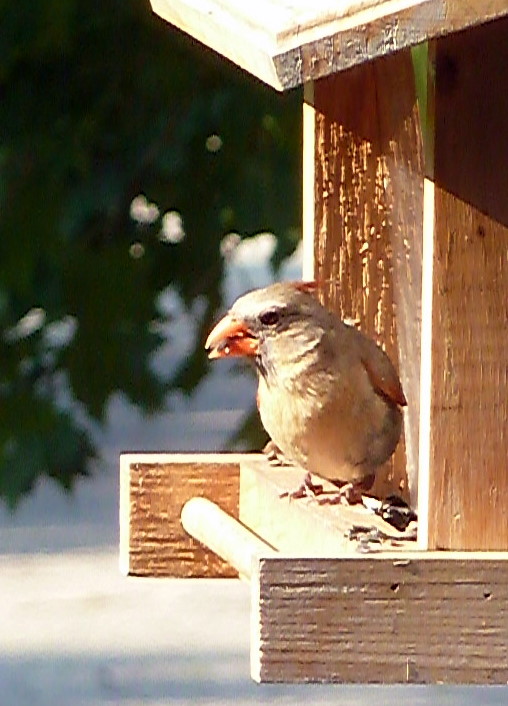
Female Northern Cardinal
I don't see our local pair of cardinals too often, and if I see one alone it's usually the male, but the female spent a little time at our feeder yesterday. Here she is maneuvering a seed in her broad beak. Her orange crest is lying flat -- I'm not sure why; perhaps it's a sign of nervousness at the feeder, but cardinals and other crested birds seem to be able to raise and lower them to communicate different moods or intentions.
My blog friend Richard of in Atwater, MN, has some nice photos of fledgling cardinals with awkwardly transitional, blotchy-colored feathers and beaks that are changing from dark to the red-orange of the mature birds. We haven't seen any juvenile cardinals at our house yet, but I'm hoping we will. We certainly have plenty of young grackles, house finches and squirrels.
Subscribe to:
Posts (Atom)