Friday, December 21, 2012

Dark-eyed Junco

I write today to celebrate the junco. Dark-eyed juncos are members of the sparrow family that are seen only in the colder months here in southern Minnesota and in much of the middle part of the U.S. For this reason they are sometimes called snowbirds. They breed in Canada and Alaska, as well as in year-round territories in northern parts of the Great Lakes states (including northeastern Minnesota), the West and the Northeast.


The junco's pale pink beak is a key identifier, as is the strong contrast between the dark gray or brown top and the white belly. Males and females are similar, though the females' color is more muted. There are regional variations in coloration -- so much so that until the 1980s they were treated as several distinct species. The Cornell Lab of Ornithology notes:
A field guide is the best place to look for complete illustration of ranges and plumages, but in general there are two widespread forms of the Dark-eyed Junco: “slate-colored” junco of the eastern United States and most of Canada, which is smooth gray above; and “Oregon” junco, found across much of the western U.S., with a dark hood, warm brown back and rufous flanks.
Juncos eat seeds and insects and usually feed on the ground, as is typical for sparrows, and so they don't often come to our feeders, though they are often to be seen foraging underneath them. They are regular visitors to our yard, though typically not in large numbers.

Yesterday morning we got a few inches of new snow from the edge of the big storm that shut down Iowa and other midwestern states. The snow covered the typical seed litter under our feeders, and while I was at home at lunchtime, I saw a junco trying to get a peanut from our peanut feeder. That's not a sight I've ever seen before. So I swept away the snow from a section of our front walk and put out some seed on the ground for the juncos.
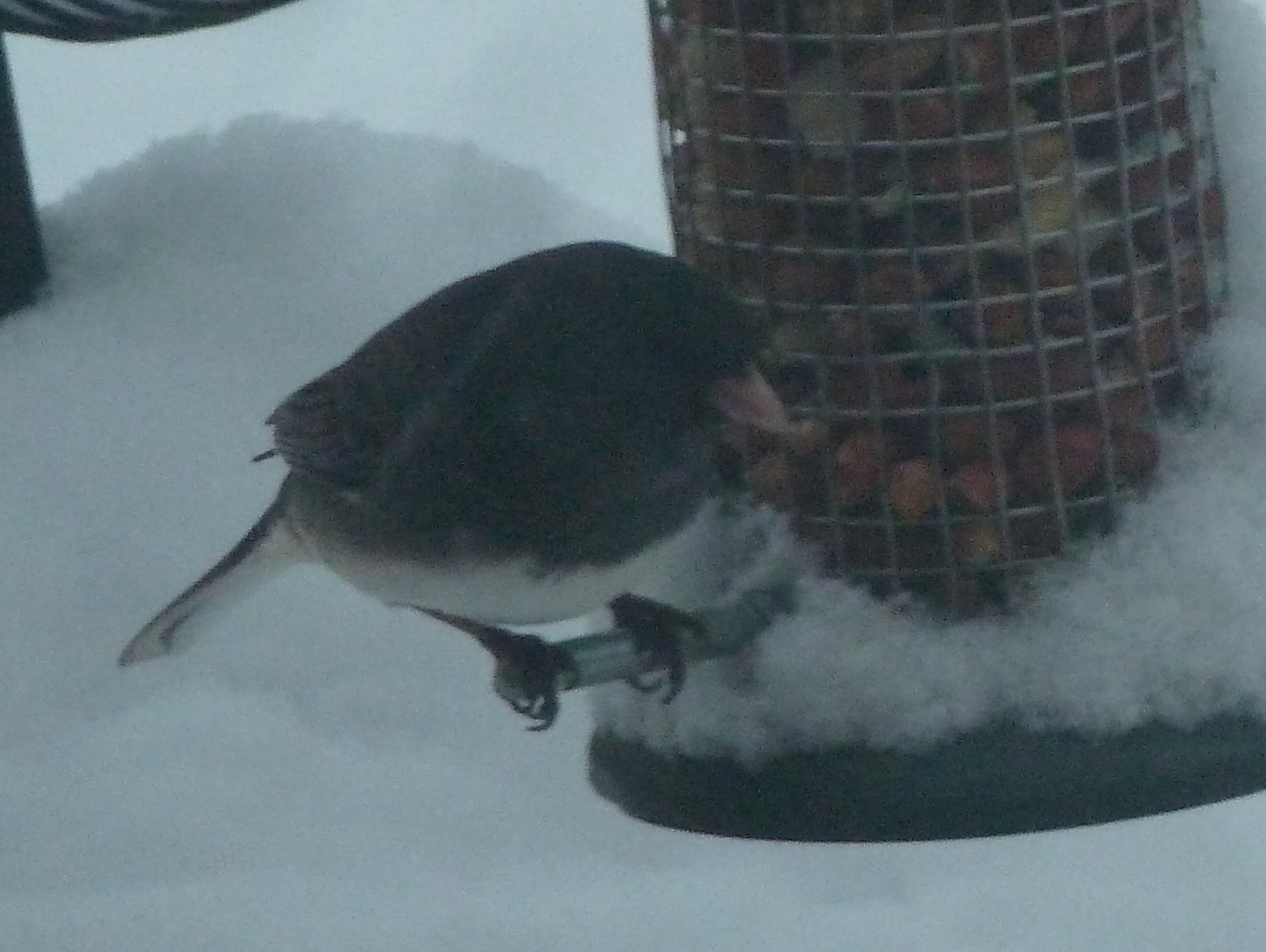

They are cute little birds, and we're always happy to see them.

Tuesday, December 11, 2012

Snow Snow Snow!


Wow! Biggest snow in a year and a half. We had about eight inches here in Northfield on Sunday, and a foot or more north of us in the Twin Cities and beyond. I'll just let the photos tell the story.


Sunday, December 2, 2012

Red-bellied Woodpecker


We've been seeing a red-bellied woodpecker in the big maple in front of our house and sometimes at our peanut feeder in recent weeks -- several days in a row a few weeks ago, and occasionally since then. This photo is a bit grainy, but otherwise not a bad capture for a foggy morning, which it certainly was this morning. In fact, there was a freezing fog advisory - not a common occurrence.

It wasn't until uploading this photo just now that I realized that this is a female - her red cap sits more on the back of her head, rather than extend over the top of the head as it would with a male. Below is a photo of a male that visited one of our suet feeders one cold morning in 2011. You can see that his bright red cap comes all the way over the front of the head to the top of the beak.


I'm not sure if we have been seeing only a female in our recent sightings, or sometimes a male. I'll have to look more carefully from now on. We just noticed quite a large (maybe 3-4" in diameter), rather fresh-looking hole in a branch in the tree that's shown in the top photo, and are wondering whether this/these red-bellied woodpecker(s) is/are responsible. We'll keep an eye on it and give an update if we get additional clues.

Wednesday, November 28, 2012

[Updated] Canada Geese at Sunset

Correction: This post has been amended to delete the erroneous identification of some of these geese as cackling geese, a smaller, shorter-necked, smaller-billed relative of the Canada goose. I am informed by one of my local birding mentors, Gene Bauer, that these are in fact simply shorter-necked Canada geese. The cackling goose is noticeably smaller in body, closer to the size of a mallard, and has a smaller, more pointed bill, and Gene tells me it would be highly unusual for us to see them in such large numbers as shown here.


I'd recently heard that hundreds of Canada geese have been gathering on the Superior Drive pond. Having taken a vacation day today, I was free to wander over that way as the sun was setting about an hour ago to see for myself.


Here's a view (above) of the east end of the pond, covered with geese and a few mallards. While I was there, many birds took to the air. Click on the photo below for a larger view of many dozens of geese in the air while dozens remain in the west end of the pond.


I noticed that many of the geese were actually cackling geese, which are smaller and have shorter necks than the Canada goose.  [See correction at top of this post.]


Here's a closer view (above). You can see both Canada geese (front right and left rear) and cackling geese (center) for easy comparison. Click on the photo to see it larger.

The Cornell Lab of Ornithology says of the cackling goose:
Formerly considered the smallest subspecies of one variable species [i.e., the Canada goose], recent work on genetic differences found the four smallest forms to be very different. These four races are now recognized as a full species: the Cackling Goose. It breeds farther northward and westward than does the Canada Goose.


There was a lovely milky sunset against which the skeins of airborne geese could be seen in silhouette. My camera battery was running low, so I turned for home.

Sunday, November 11, 2012

24 Pine Siskins!

This weekend Project Feederwatch got started for the season (it runs November to April), and there has been plenty to see. A cold, wet front came through last night, taking us from a record-breaking high of 69 F (official Twin Cities temperature; several sources showed it to be even warmer than that here in Northfield) yesterday afternoon to the upper 50s at midnight to the upper 20s currently. Perhaps as a result of this change in the weather, there was a great deal of activity at our feeders today -- but actually we've had plenty of activity anyway, recently.

However, today there was one noteworthy appearance. In addition to house finches, chickadees, a downy woodpecker, blue jays, dark eyed juncos, and both white-breasted and red-breasted nuthatches, we've had quite an invasion of pine siskins. These are small, streaky finches that are cold-season-only birds for us here in southern Minnesota when they are here at all -- depending on the availability of their preferred seed crops, they may be present in large numbers one winter and barely seen another winter. 

We'd been seeing a couple occasionally for several weeks and then a few days ago Dave counted 14 while I was at work. Today we had at least 24 at the house. I saw many, many in the big maple tree out front (the staging area from which many of our visiting birds approach our feeders), then went over to the small window from which I can take a close look at the feeders they prefer, and at that point (no longer being able to see if some were still in the tree) I counted a dozen on the ground, seven in the caged feeder and five on the sock feeder.

In the photo below, one goldfinch in winter plumage keeps company with four pine siskins. Goldfinches and pine siskins are very similar in size and body style, with small, sharp beaks, but the goldfinches have a clear breast (nicely displayed below) while the siskins are heavily streaked all over.

Goldfinch (center left) and pine siskins

In our four years of feeding birds at this location, and two prior years of keeping nearly weekly count of what we see during Project Feederwatch, this was by far the largest number of one species we've seen at a single time. I think 14 house finches was the highest count we've had before.

Seven (visible) pine siskins

It's been many weeks since my last post here. As I was looking back to see what photos I had taken since the end of summer, I came across this shot of goldfinches at the sock feeder in mid-September. These males were looking a little patchy as they were changing from their brilliant lemon-yellow summer plumage to their more sedate winter plumage (as seen in the top photo above).

Moulting goldfinches in mid-September

Our summer birds have mostly left us by now, and I wonder what kind of winter we have ahead of us. We've had nearly nine months of no winter, since our amazing early warm spell last March (nine months of no winter may be normal many places, but not in Minnesota!), and the winter that came before that was exceptionally mild. I feel ready for the "indoor season" to begin. But I know it's not indoor season for the birds that stay, and they've got hardships ahead. We'll keep our feeders full to help them see it through.