Showing posts with label organic food. Show all posts

Saturday, August 22, 2009

Time Magazine Cover Story: Real Cost of Cheap Food

This week Time magazine gives cover-story prominence to an issue I feel strongly about: namely, that the industrial-scale cheap food we have become accustomed to comes at too high a price and is not sustainable. The article notes:
The U.S. agricultural industry can now produce unlimited quantities of meat and grains at remarkably cheap prices. But it does so at a high cost to the environment, animals and humans.
Price subsidies for commodity crops result in price-per-calorie dysfunction like these examples provided in the article. One dollar can buy:
  • 1,200 calories of potato chips
  • 875 calories of soda
  • 250 calories of vegetables
  • 170 calories of fresh fruit
The fruit and vegetables are still the nutritional bargain here, but people get fuller faster (and fatter) eating the cheap calories.

When we enjoy a cheap hamburger from animals finished on grain in high-density feedlots, or bargain-price pork or chicken where thousands of animals are raised together in close proximity, we are getting that cheap meat at the cost of:
  • a horrendous (at the very least, a most unnatural and crowded) quality of life for the animals
  • routine antibiotic use to prevent control disease in such unnaturally large concentrations of animals
  • pollution from the huge quantities of waste produced in such concentrated areas
  • increased chances for food contamination from large, high-speed processing plants
  • increased use of petroleum-based fertilizers to grow the endless monocultures of cheap corn to feed the animals
  • our own health and enjoyment of the food (did you know, for example, that the fats in grass-fed beef and dairy products - such as humans have been eating for thousands of years until the last several decades - are considerably better for us than the fats from grain-fed cattle?)
Bon Appetit food services company (which manages the dining programs at both St. Olaf and Carleton colleges here in Northfield and relies heavily on local, sustainable producers), Niman Ranch beef, and Chipotle restaurants are highlighted as examples of how to take a different, healthier, more sustainable approach in large-scale food production. Our own nearby Thousand Hills Cattle Company is a premium source of grass-fed beef; you can find their meat at Just Food and other area co-ops, and I believe I even saw some at EconoFoods recently.

I encourage you to read the article, which concludes:
The industrial food system fills us up but leaves us empty — it's based on selective forgetting. But what we eat — how it's raised and how it gets to us — has consequences that can't be ignored any longer.

Saturday, November 3, 2007

Major Study Finds Organic Food More Nutritious

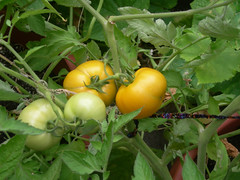
TomatoesThe last several days have seen reports of the early findings from one of the largest-yet systematic studies of whether organic foods show any nutritional advantage over conventional foods -- and the answer is yes.

Last weekend the Sunday Times reported:
Official: organic really is better

THE biggest study into organic food has found that it is more nutritious than ordinary produce and may help to lengthen people's lives.

The evidence from the £12m four-year project will end years of debate and is likely to overturn government advice that eating organic food is no more than a lifestyle choice.

The study found that organic fruit and vegetables contained as much as 40% more antioxidants, which scientists believe can cut the risk of cancer and heart disease, Britain’s biggest killers. They also had higher levels of beneficial minerals such as iron and zinc.

Professor Carlo Leifert, the co-ordinator of the European Union-funded project, said the differences were so marked that organic produce would help to increase the nutrient intake of people not eating the recommended five portions a day of fruit and vegetables. “If you have just 20% more antioxidants and you can’t get your kids to do five a day, then you might just be okay with four a day,” he said.

This weekend the Food Standards Agency confirmed that it was reviewing the evidence before deciding whether to change its advice. Ministers and the agency have said there are no significant differences between organic and ordinary produce.

Researchers grew fruit and vegetables and reared cattle on adjacent organic and nonorganic sites on a 725-acre farm attached to Newcastle University, and at other sites in Europe. They found that levels of antioxidants in milk from organic herds were up to 90% higher than in milk from conventional herds.

As well as finding up to 40% more antioxidants in organic vegetables, they also found that organic tomatoes from Greece had significantly higher levels of antioxidants, including flavo-noids thought to reduce coronary heart disease.

Full results of the study are expected to be released over the course of the coming year.

Addendum: Why, I wonder, is the mainstream US media not picking up this story? It is all over the British, Indian and Australian press, and is being discussed as might be expected on sites that have an organic or food-industry focus, but I've looked through page after page of Google search results and found nothing from CNN, the New York Times, MS/NBC, etc.

Thursday, September 6, 2007

Big Business Organic

While browsing another local-foodie blog, Dirt to Dish (written by Katherine Gray, who has posted comments here) , I came across a reference to an enlightening chart showing the huge multi-nationals that own some of our most familiar organic brands. Santa Cruz Organics? Owned by J.M. Smucker. Stonyfield Farm and Brown Cow yogurts? Owned by Dannon. Nantucket Nectars? Cadbury-Schweppes.

Organic has gone mainstream, finding its way into Wal-Mart, Target, and just about every other major grocery outlet. We read that supply is having a hard time keeping up with demand for organics (see my blog post from July, "Helping farmers make the switch to organic"). Is this good? Is it a great victory? Or is it a sell-out? Does it inevitably mean a deterioration of what organic really means if it's being supplied by big business?

Well, no... and yes. I have to think that on balance it means, at the very least, that more soil is being enriched and fewer pesticides are being used on our one and only planet than would be the case if organic hadn't gone mainstream. I think many of the supporters of organic farming always hoped it would become mainstream -- "the way food is grown," not just a tiny subculture.

And yet. There is a fear that when organic farming becomes big business, it loses something -- perhaps not the essentials (returning organic matter to the soil, avoiding chemical fertilizers and pesticides), but the sense -- perhaps an overly romantic one -- that organic gardening by its very nature should involve a commitment to place, to a particular soil, to a particular location, to a particular ecosystem and a particular community. When it's run, or at least owned, by billion-dollar corporations and its fruits are transported by carbon-and-particulate-matter-spewing trucks all over the nation, hemisphere or world... when production involves thousands of ill-paid farm laborers... when it's commodified on a global scale, that doesn't feel organic anymore. It's Big Food Conglomerate, not Hard-working Local Farmer committed to the health of his or her own patch of earth.

And yet. Big business is here to stay. Big business is vital to national economies. Big business can take, and I think should be praised for taking, steps toward improving its green credentials. Just because it's big business, it doesn't mean every action is cynical and heartless. It might in fact be, but if the results are a step in the right direction, that's still worth something.

Sunday, August 26, 2007

A Tale of Two Tortillas: Local vs. Organic

There is always something of a tension for a local food advocate between supporting local products that may not be organic or free of genetic modifications and supporting more distant producers of foods that do have those qualities. I made a point recently of asking the Just Food staff for local tortillas, since I am trying to keep my food as local as possible in general and in particular during the Eat Local Challenge, which runs through September 15. Responsive as always, the co-op soon thereafter had white corn tortillas from Faribault's Aztlan Tortilleria in their refrigerator case, and I'm aware that they have offered these in the past as well. They sit side-by-side with Sonoma brand organic tortillas from California, which I've also purchased before.

In the case of tortillas, I feel the "eat local" advantage is mainly economic: I'm supporting a local business that adds to the economic health of its owners and this region. I don't know what their source of corn is. Given how much corn is grown in the Midwest, I would hope it is a relatively local source. However, information published by the Corn Growers of America, in response to the suggestion that the diversion of more U.S. corn to ethanol production has raised tortillas prices in Mexico, states that very little -- only about 1% of production -- white corn, as opposed to yellow corn, is produced in the U.S.

Thus, it seems likely -- though I hope to learn otherwise if it's the case -- that the corn for my locally produced white-corn tortillas may actually come from Mexico, perhaps farther away than the organic corn tortillas produced in California. I want to support farmers anywhere who pursue organic, sustainable production. I also want to support my local economy. It looks as if in this case the difference in "food miles" between the two may be inconsequential -- a conclusion that should probably tilt my decision most often toward buying the organic tortillas. However, I do see value in supporting our local businesses. As a result, I'll probably be relatively happy supporting either product, depending perhaps on my mindset on a given shopping day. The tortilla producers that will see less of my purchasing dollars are those that are neither local nor organic.

I welcome your thoughts on where you come down on weighing local vs. organic sources when a choice between the two is presented.
Posted by Picasa

Friday, July 27, 2007

Helping Farmers Make the Switch to Organic

A recent report on Minnesota Public Radio notes that the supply of organic food -- including organic feed for livestock -- isn't keeping up with demand. Farmers have been slow to switch from conventional crops to organic, but a county in Northwest Iowa is trying to do something about that:
"There are efforts underway to encourage farmers to make the leap. In Minnesota, the state helps pay the cost to certify a farm's organic status.

"In Northwest Iowa, there's a more ambitious program. Officials in Woodbury County, the Sioux City area, are trying to build an organic food industry. As part of the effort the county has trademarked the brand name "Sioux City Sue Foods," based on the old country music song. Local farmers can use the name to market their products. The county offers tax breaks and other incentives to farmers who switch to organic production.

"Woodbury County Rural Economic Development Director Rob Marqusee says he hopes to attract a major soybean processor to the area. Marqusee says organic foods are one issue where local governments can lead. ...

"He says Woodbury County is trying to build a farm to market infrastructure for organic foods. Things like processing plants, storage units, shipping links. Already the Whole Foods Market chain has starting buying from county farmers."
Read more and listen to the piece here.