Showing posts with label environmental costs. Show all posts

Sunday, August 12, 2007

Looking Beyond Food Miles: Star Trib Commentary

James E. McWilliams, author of "A Revolution in Eating: How the Quest for Food Shaped America," wrote a thoughtful piece that appeared in the Star Tribune's Commentary section on Thursday:
Does eating local really help the environment? Not always. Other factors, from growing techniques to method of delivery, can outweigh the simple calculation of 'food miles.'
He proposes looking at a food item's life-cycle carbon and resource-use footprint -- things like water and fertilizer use and mode of transportation -- rather than simply at how many miles it has traveled. That, of course, is harder to know, and will depend on plenty of independent analysis.

Not too surprisingly, New Zealand -- about as far as you can get from anywhere in Europe or the Americas, and a prime source of our out-of-season apples -- has seen a need to respond to the local food push. University researchers there have published their findings that, due to naturally lush pastures and other factors, New Zealand lamb shipped by boat to Britain produces about one-fourth the carbon emissions per ton than British-raised lamb. Fruit and dairy products fared similarly.

McWilliams, who describes himself as a passionate "eat local" advocate, concludes:
While there will always be good reasons to encourage the growth of sustainable local food systems, we must also allow them to develop in tandem with equally sustainable global counterparts. We must accept the fact, in short, that distance is not the enemy of awareness.
Read the full piece here.

Sunday, July 22, 2007

Why Eat Locally? (Part one of an ongoing discussion)

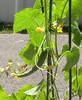
cucumber-on-vineWhat's the big deal? Why should we make a point of eating more locally grown and produced foods? Over the next few weeks I'll discuss some of the reasoning I've found persuasive, starting with one of the real biggies:

  • Reduce fuel dependency: According to research summarized in Animal, Vegetable, Miracle ("AVM"), Americans consume about 400 gallons of oil a year per citizen for agriculture. About 20% is due to fuel use in production, including large-scale farming's heavy reliance on petroleum-based fertilizers, pesticides and herbicides. 80% is attributable to getting food from the farm to the table, including transport, warehousing, packaging and refrigeration.
"Each food item in a typical U.S. meal has traveled an average of 1,500 miles... If every U.S. citizen ate just one meal a week composed of locally and organically raised meats and produce, we would reduce our country's oil consumption by over 1.1 million barrels of oil every week." (AVM, p.5)

We've come to a point, here in the year 2007, where talk of man-made global warming is no longer dismissed as fiction and the environmental and political costs of being so reliant on fossil fuels have finally penetrated the American psyche. The need for a change in our fuel-consumption behaviors is almost universally acknowledged. Eating locally is something we can do about it, starting today.

To be continued...