Sunday, January 20, 2013

Ring (of Pine Siskins) Around the Rosie


I recently happened to capture this nice threesome of pine siskins encircling our Nyjer (niger) seed feeder. As you can see, the birds were concentrated in the bottom few inches of the feeder because we had let the seed supply run low. When the feeder is full, they tend to arrange themselves more vertically.


In the photo immediately above, you can see (especially if you click on the photo to see it larger) a bit of the yellow feathers on the wings on the bird on the right. A better view of this distinctive splash of yellow can be seen in the photo below, taken in December 2010.


I have written about pine siskins in several earlier posts, collected here.

Wednesday, January 2, 2013

Life Seen Upside-Down - Happy New Year!

I thank my birding/blogging/Facebook friend Ruthie, of Nature Knitter, for the opportunity to take these photos of a white-breasted nuthatch on her distinctive ball-shaped feeder (a gift, I understand, from another birding/blogging/Facebook friend, Lynne, of Hasty Brook), as seen from Ruthie's dining room on New Year's Day. We were celebrating the birthday of her bubbly, personality-filled dog Holly the Pibble, who could win over a legion of pit bull detractors.

An unusual perspective on a habitually upside-down bird

Thanks to the seemingly dozens of feeding stations visible from Ruthie's windows, I kicked off 2013 with fabulous views of 13 kinds of birds (white-breasted nuthatch, red-breasted nuthatch, house finch, black-capped chickadee, dark-eyed junco, house sparrow, downy woodpecker, hairy woodpecker, red-bellied woodpecker, northern cardinal and blue jay) in addition to the crows, pigeons, wild turkeys and hawks I'd seen from the highway.

A more normal view of one of my favorite birds

I do love white-breasted nuthatches, as well as their smaller red-breasted cousins. We have both a male and a female very regularly at our peanut feeder at home this year. Last year at about this time I wrote that we had really just started to see the female (assuming it is the same pair), though the male had been a frequent visitor, and that I hoped she'd get more comfortable visiting our feeders. It seems she has.

Female white-breasted nuthatch (Jan. 2011)

I have some more recent photos of the female, but none I like as well as this shot of her soaking up some rays, or maybe just resting and conserving energy, on a very cold but sunny day last January.

This year, may you have interesting encounters with natural places and wild beings. Notice what you see. And, if you like, show someone, or tell someone about it (me, if you like -- in comments here, or email me at penelopedia @ gmail . com. I would love to hear your stories.)

“Many eyes go through the meadow, but few see the flowers in it.” 
― Ralph Waldo Emerson


Monday, December 24, 2012

Holiday Greetings


Merry Christmas and warmest wishes at this special time of year, when the light begins to return but months of cold still lie ahead for those of us in the northern realms. I so appreciate my readers, and I love getting your notes. Thank you for following Penelopedia and letting me share my observations with you.

May your days be merry and bright, and may all your Christmases be white!

Friday, December 21, 2012

Dark-eyed Junco

I write today to celebrate the junco. Dark-eyed juncos are members of the sparrow family that are seen only in the colder months here in southern Minnesota and in much of the middle part of the U.S. For this reason they are sometimes called snowbirds. They breed in Canada and Alaska, as well as in year-round territories in northern parts of the Great Lakes states (including northeastern Minnesota), the West and the Northeast.


The junco's pale pink beak is a key identifier, as is the strong contrast between the dark gray or brown top and the white belly. Males and females are similar, though the females' color is more muted. There are regional variations in coloration -- so much so that until the 1980s they were treated as several distinct species. The Cornell Lab of Ornithology notes:
A field guide is the best place to look for complete illustration of ranges and plumages, but in general there are two widespread forms of the Dark-eyed Junco: “slate-colored” junco of the eastern United States and most of Canada, which is smooth gray above; and “Oregon” junco, found across much of the western U.S., with a dark hood, warm brown back and rufous flanks.
Juncos eat seeds and insects and usually feed on the ground, as is typical for sparrows, and so they don't often come to our feeders, though they are often to be seen foraging underneath them. They are regular visitors to our yard, though typically not in large numbers.

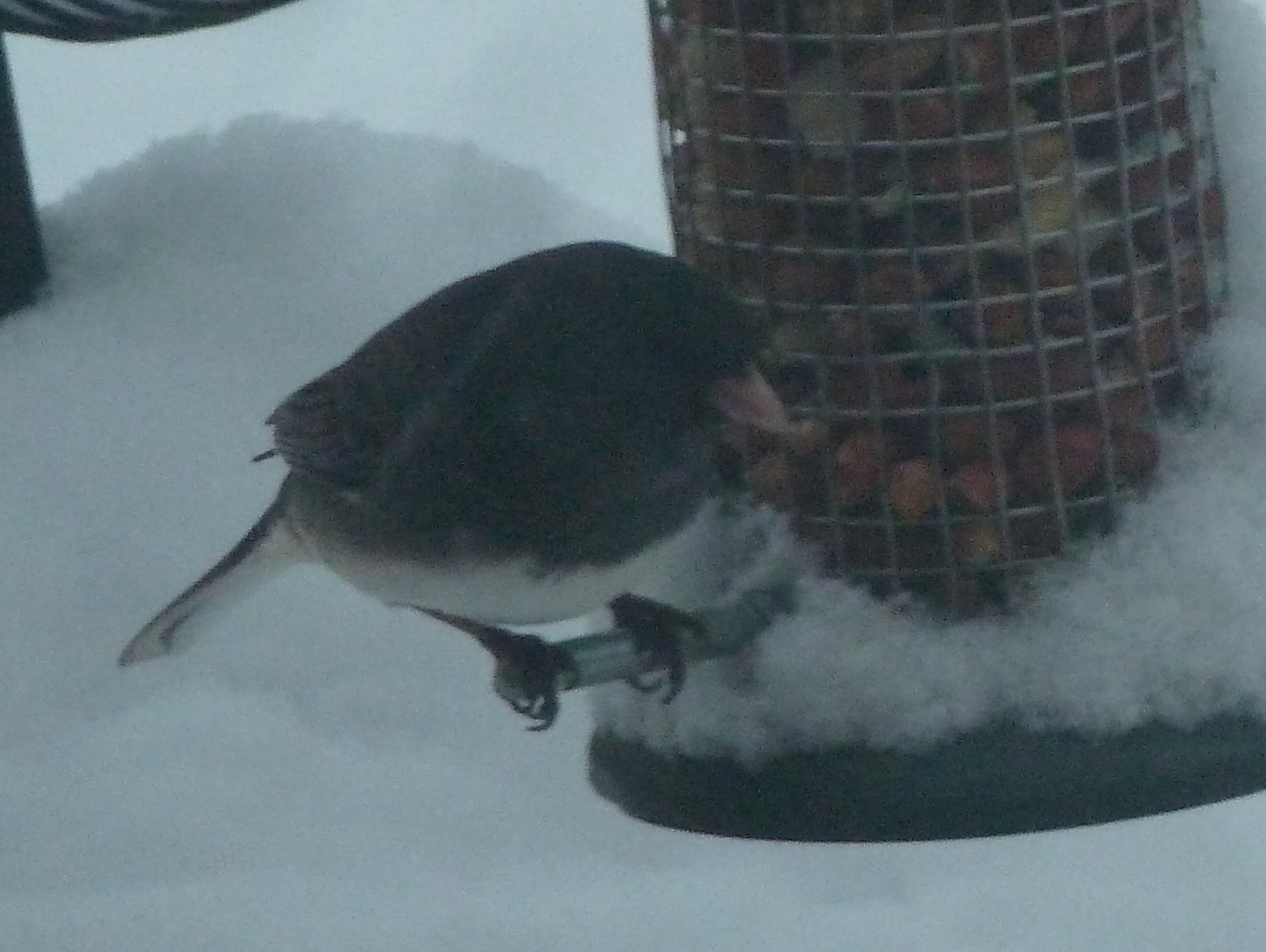
Yesterday morning we got a few inches of new snow from the edge of the big storm that shut down Iowa and other midwestern states. The snow covered the typical seed litter under our feeders, and while I was at home at lunchtime, I saw a junco trying to get a peanut from our peanut feeder. That's not a sight I've ever seen before. So I swept away the snow from a section of our front walk and put out some seed on the ground for the juncos.


They are cute little birds, and we're always happy to see them.

Tuesday, December 11, 2012

Snow Snow Snow!


Wow! Biggest snow in a year and a half. We had about eight inches here in Northfield on Sunday, and a foot or more north of us in the Twin Cities and beyond. I'll just let the photos tell the story.