Thursday, June 26, 2014

Viceroy Butterfly


When Dave and I saw a couple of orange butterflies flitting near us on the access driveway while we were checking the bluebird nestboxes on our prairie trail on Sunday, we were excited, thinking they were monarch butterflies. Monarchs, of course, have seen precipitous declines over the last few years due to a variety of factors including reduced availability of their essential food, milkweed.


Being the careful reporter I try to be, and knowing that there is another butterfly that looks very like the monarch, I did a little research before posting these photos. And it was a good thing I did, because this is a viceroy butterfly, not a monarch.


Here (below) is a photo of an actual monarch that was visiting the purple coneflowers in our front yard in 2010:


The monarch has more large light spots on the leading edges of its forewings and more small spots along the trailing edges of its wings, and the viceroy has a narrow line across its hindwings, which the monarch does not have and which is probably the easiest field mark to go by. The monarch also has pale lines across its body, while in the top photo of the viceroy, above, you barely even notice the uniformly dark body. The monarch is also slightly larger than the viceroy, but the difference is hard to tell without a side-by-side comparison in the field.

Viceroys feed on poplar, cottonwood and willow trees, and like the monarchs have (relatively recently) been found to be distasteful to bird predators, due at least in part to their bodies' retention of the salicylic acid found in their food. Their similarity to the monarch is now being argued to be a likely example of Müllerian mimicry, with each unpalatable species benefiting from its similarity to the other, rather than Batesian mimicry, where a palatable or nondangerous species benefits from its similarity to a unpalatable or dangerous species. (For more on the mimicry issue, see http://www.britannica.com/blogs/2011/05/mutual-mimicry-viceroy-monarch.)

In my research I came across a wonderful Minnesota nature blog I hadn't discovered before: Backyard Biology, authored by a mother-daughter pair (one a recently retired biology professor and the other a former biology major, nurse, and at-home mom). Their viceroy-monarch comparison appears here. They've recently been writing about the importance of prairies, as I have, with beautiful photos. Check it out.

Sunday, June 22, 2014

Musings on Grass and Economics

Dave and I attended the wonderful Potholes and Prairie Birding Festival in Carrington, North Dakota, June 11-15, and then headed south and farther west to Pierre, South Dakota, and the Missouri River to do more birding on our own. I'll post separately about some of the great birds and other sights we saw. But first, I feel impelled to write about grass. Grass -- and economics.

Prairie and pothole country, central North Dakota

I've written before about our vanishing grasslands (for example, the fact that only two percent of the original, pre-European-settlement tall-grass prairie in Minnesota remains, in fragmented and isolated pockets) and the profound effect the loss of that habitat is having on grassland birds like bobolinks, meadowlarks, and many others. With that consciousness firmly in mind, this trip was both elating and sobering.

Site where we saw a Sprague's Pipit "skylarking"

It was exhilarating and reassuring to see that miles upon miles of empty, rolling grasslands do still exist in some places -- to look around and breathe the clean air and see almost nothing but prairie and sky in every direction.

A never-cultivated prairie area on "school land" in North Dakota

So it was elating, but it was also sobering. That's because although much remains in some areas, grasslands are being converted to croplands at a pace not seen for decades. Record prices of corn and other commodities are leading many landowners to take land out of grazing or out of the Conservation Reserve Program (CRP). Almost everywhere we went, we could see what we were told by our guides were newly cultivated and planted fields.

Abandoned houses are a common site in the Northern Plains

Once sprayed and cultivated, even if the land is eventually turned back to a more natural state, and despite any restoration efforts (helpful though they can be), it will never have the rich mix of native plants that once existed. A prairie plowed is a prairie lost. If one believes that the current demand for corn-based ethanol will be a short-lived phenemenon, as many do, it's particularly painful to think of these lands being converted for short-term gain, and their original inherent habitat and grazing value not regained in probably many lifetimes.

American White Pelicans in flight in prairie-pothole region, North Dakota

Grazing is another traditional economic use for grasslands, of course. We heard from our birding guides and workshop instructors -- including prairie expert Stephen R. Jones -- that grazing (ideally by migrating bison, but also acceptably by well-managed cattle herds)  is essential for the maintenance of healthy grasslands, as is fire. Without these controls, invasive species move in and you get an inevitable progression of the grassland ecosystem toward more shrubs and trees. 

Grass and sky, North Dakota

Grass-fed beef and bison are increasingly popular food choices these days, which is an encouraging development for the future of grasslands. However, we also heard from knowledgeable people that in the modern era it's just plain easier to be a crop farmer than a rancher. When you ranch, you are responsible for the well-being of the animals year-round, while crop farmers can go to Florida in the wintertime if they like. And in the Dakotas, some winter respite is quite naturally welcomed by many.

Bison above the Missouri River near Pierre, S.D.

So it's evident that economic benefit is a hugely important consideration in how land is used or set aside. We can't just wring our hands and wish people would nobly leave the grasslands unplowed. People who live in this important ecosystem still need to support their families and aspire to a decent quality of life. Economic incentives -- whether in the form of new or different subsidies, and/or the creation of new land conservancies, and/or the sale of conservation easements, and/or rising demand for grass-fed beef and bison, or other incentives -- will be an essential consideration in saving these lands, if they're to be saved. It's an issue I'll continue to follow closely. And I hope to return many times to this beautiful region.

High country near Pierre, S.D.


Friday, May 9, 2014

Must Be Time for Orioles and Grosbeaks!

May 7, 2011 - First-ever visit of  rosebreasted-grosbeaks to our feeders. I wrote a blog post titled "Thought I'd Died and Gone to Heaven."
May 8, 2011 - First-ever visit of Baltimore orioles to our feeders (but they'd been seen in the trees the few days before) (Described in a blog post on May 15)
May 8, 2013 - Rosebreasted grosbeaks and Baltimore orioles show up at our feeders within 15 minutes of one another
May 7, 2014 - Orioles and rose-breasted grosbeaks show up within a few hours of each other (and hummingbirds later that day as well). First-ever visit of orchard orioles to our feeders, and we see half a dozen each (or more) of orioles and grosbeaks at our feeders and in our big tree. Wowee! Photos below.

Male Baltimore Oriole, May 7, 2014

Male Rose-breasted Grosbeak, May 7, 2014

Female Rose-breasted Grosbeak, May 7, 2014

Orchard Oriole, May 7, 2014

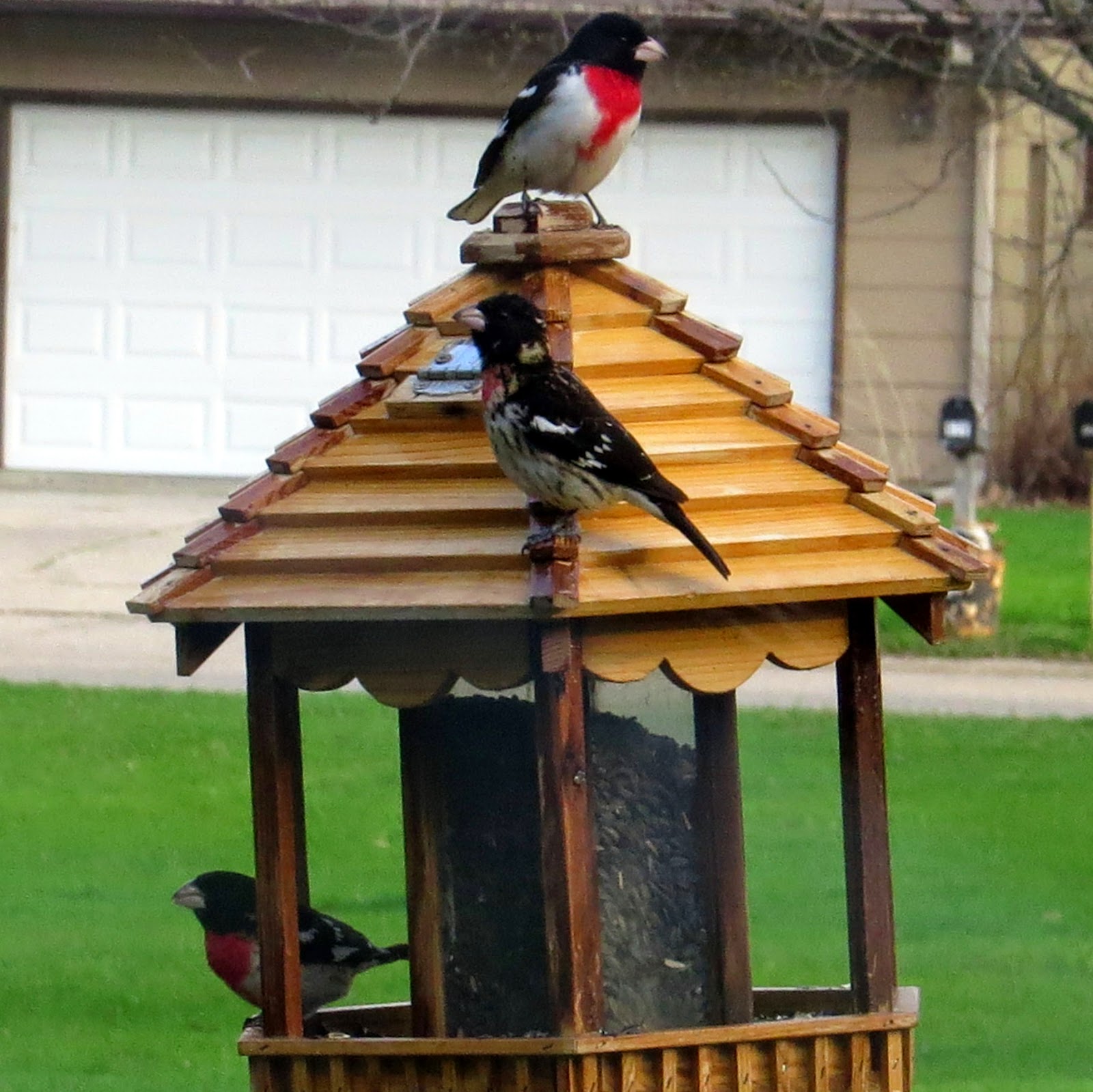
The grosbeaks really seem to like the gazebo-style feeder, which was new last fall. It is easy to approach and fits several at a time. I think that's why so many have stayed around these last few days.

Rose-breasted Grosbeaks

I didn't notice until looking at these photos just now that the photo below clearly shows an immature male grosbeak sitting toward the front of the gazebo roof -- he's developing his dramatic coloring but still has some of the streaks that juveniles and females share. I noted one last year, too, and wrote a little more about that then.

Rose-breasted Grosbeaks - note immature male in front

The photo below does not show a romantic interlude: Rather, two male orioles had a competitive moment over the jelly.

Male orioles get feisty with jelly on their beaks

It's been a wonderful few days. Happy spring!

Tuesday, May 6, 2014

Enjoying White-throated Sparrows

Before they're gone again, I must comment on the wonderfully audible presence of white-throated sparrows over the past couple of weeks. They don't stay here long as they move through to preferred breeding territory, but we love hearing and seeing them while they are here. They are often to be found foraging on our front lawn or under our hanging feeders. They're so pretty, and their song is so sweet.

White-throated Sparrow, white-striped morph

White-throated Sparrow, white-striped morph

There are two color morphs of these sparrows. The two photos above show the white-striped morph. Below is the duller, tan-striped morph. They mingle freely, seem to prefer mates of the other morph, and thus occur in equal numbers throughout their range. David Sibley has a nice discussion of their characteristics here. One excerpt: 
Comparing like sexes, White-striped birds are more aggressive, sing more, and spend less time in parental care than Tan-striped. Regardless of sex, White-striped tend to dominate Tan-striped birds in the breeding season. Mated pairs almost always include one of each morph, and because of the chromosome arrangement this pairing always produces equal numbers of Tan-striped and White-striped offspring (Falls and Kopachena, 2010).

White-throated Sparrow, tan-striped morph

I last wrote about white-throated sparrows and their song in April 2011 (when in my enthusiasm I managed to mix up a white-crowned sparrow with the white-throateds, but then set the record straight).

Sunday, May 4, 2014

Bluebird Report: 2014 First Report

We got out to prep the bluebird nestboxes in early April this year, our third year as bluebird monitors of two "trails," which now comprise 19 nestboxes. Though not quite as bad as last year's slow spring, still the cold, rainy weather has slowed things down. We have a few complete bluebird nests (also two chickadee nests) and several others have been started, but only a single nest has any eggs yet -- three eggs, as of yesterday.

When we first checked the boxes, we thought we already had a new egg in one, but determined eventually that it was an unhatched egg from the second brood last year. We should have done a final clean-out at the end of the summer. Our confusion at the start of this season is a good reminder of why it's a preferred practice to clean out the boxes at the end of the season. Some people take their boxes down; others close them up so nothing can get into them over the winter. We like the idea of leaving them accessible as roosting or shelter boxes, and we've seen some signs this year that they were used for that purpose.

Today we got some great views of a male and female bluebird at our prairie trail of four nestboxes, where we have three full nests but no eggs yet.

Male Eastern Bluebird
The many tiny scratches visible on the road sign suggest that it's a popular perching spot, as it was today.

Female Eastern Bluebird
We wish these two, and all their fellow birds, good luck as they embark upon the vital task of reproduction in 2014.

(Our bluebirding adventures began in 2012. You can follow the full story here: Bluebird Trail.)