Saturday, April 13, 2013

Winter in April and Juncos Galore (with video)

The weather has been on our minds and in our face in Minnesota this week. Just ask this squirrel.


Much-needed rain followed by sleet, snow and more snow have dragged weather more typical of early March into mid-April, and most people are pretty sick of it. There's another weather advisory out for more snow, sleet and freezing rain for tonight and tomorrow morning, and temperatures will remain below normal for some days to come. Sigh.


It's been hard on the animals and birds, as well. We've had plenty of views of robins in the snow, and rabbits came to feed on seed we'd put out by our front steps yesterday.


People in Minnesota have also been commenting on the huge numbers of dark-eyed juncos seen in the last few days. At our house in Northfield, throughout most of the winter we tend to see just a few juncos at a time -- typically just three or four, though occasionally more (we would have more, I'm sure, if we routinely scattered seed on the ground) -- but suddenly this week we were seeing first a dozen, then two dozen, then 30+ at a time.


Below is a short video clip of juncos I took yesterday feeding on seed we scattered for them under our hanging feeders. And yes, that is the juncos you hear in the video. They sound like a video game with "pyew, pyew" shooting noises, don't they? While this was going on, twice as many juncos were feeding under some of our other feeders. We have also seen them trying to eat from the hanging feeders, which -- being ground-feeding birds -- they don't generally do. I previously wrote about the dark-eyed junco in December 2012.


Northfield-based bird bander Dan Tallman reported on Tuesday that he banded 197 juncos this week, including several of the lighter "Oregon race" which are not often seen here. In an earlier post he offers a quick tutorial on the differences between the Oregon junco and our familiar "slate-colored" junco.

Central Minnesota nature blogger Richard of "At the Water" commented on seeing large numbers of juncos this week as well.

We were at Minnesota's annual Bluebird Expo here in Northfield today, and the well-known Minnesota phenologist (one who observes and studies seasonal patterns of animals and plant life) Jim Gilbert, one of the featured speakers, remarked on the large numbers of juncos. Many in the audience raised their hands to indicate that they too had been noticing flocks of juncos in the past few days. In conversation with him later, I asked him if he has seen juncos flocking in such huge numbers in previous years. He said that he has not, and he speculated that the cold front associated with the wet and then wintry weather that hit us this week may have had a "fall-out" effect on migrating birds. When the weather improves, it's likely they will be gone again very quickly.

Speaking of bluebirds, a few have been reported in the state in the past few days. By this time last year (which was truly exceptional), many bluebirds had already nested and laid eggs. This year they face a cold, rather miserable start to their breeding season.

Sunday, April 7, 2013

Red-breasted Mergansers

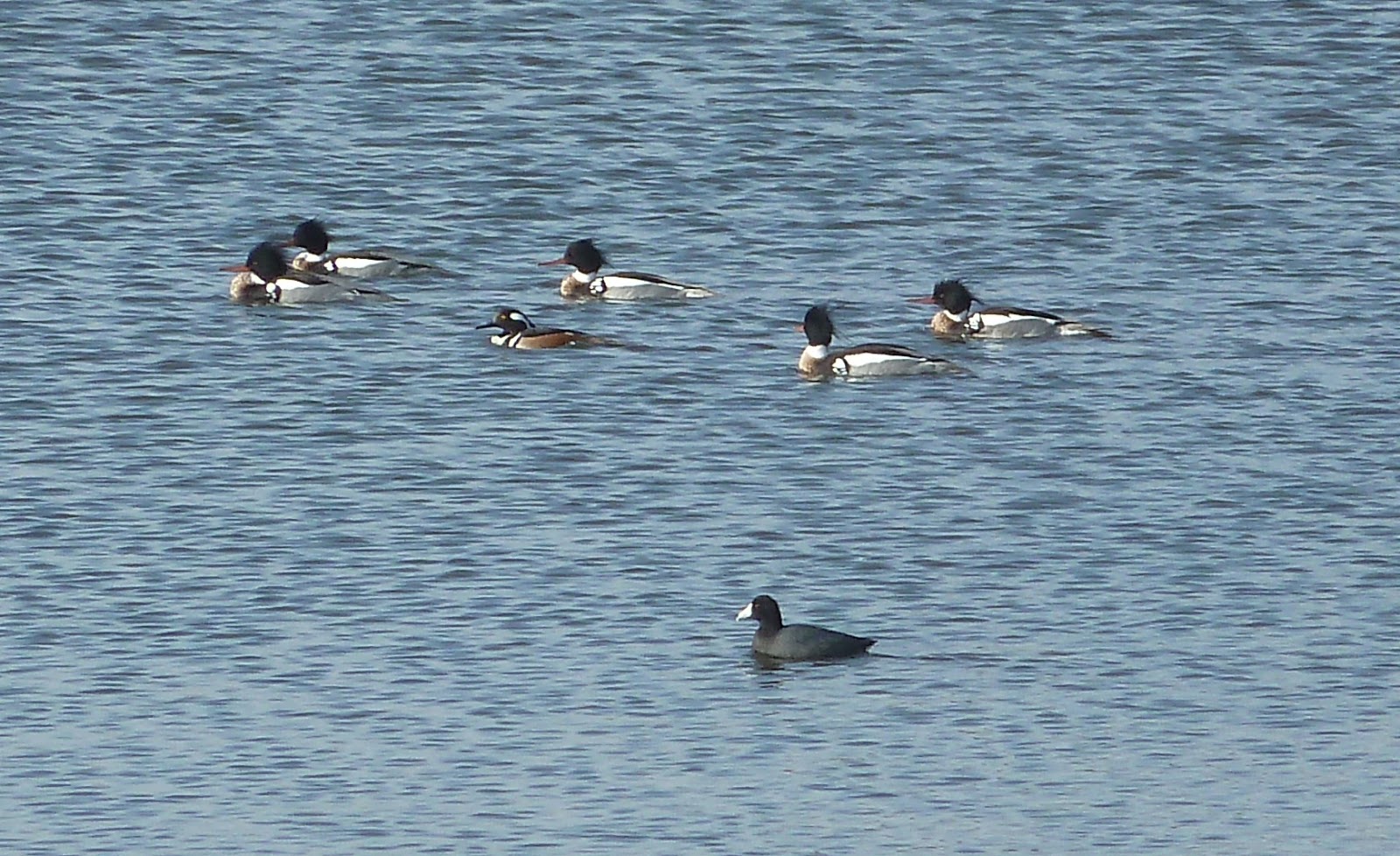
Late this afternoon half a dozen male red-breasted mergansers were on Northfield's Superior Drive pond, keeping company with several pairs of hooded mergansers.


We haven't often seen these here. In late April 2011 we saw a lone female red-breasted merganser on the same pond, and I noted that I'd only seen them before up in Grand Marais, where we'd seen a mother with ducklings in August 2008.


Mergansers are diving ducks that eat mainly fish.

(Click on photo to see it larger)

Above, a male hooded merganser is flanked by five red-breasted mergansers -- note their considerably larger size than the small hoodie, as well as their bold, dark, fluffy-crested heads. An American coot is in the foreground -- a duck-like bird that is actually more closely related to rails and moorhens than to ducks. I last wrote about coots on April 4, 2012, after we saw large numbers of them at Lake Byllesby.

This pond was still almost entirely iced over as recently as Friday evening. Yesterday's warming temperatures and the afternoon's rain, followed by sun today, cleared out the ice in a hurry. Some remains, but the pond is largely ice-free today.

We also saw several yellowlegs, probably lesser yellowlegs, on the far edge of the pond that is to the south of the large pond. These, along with some recent killdeer, have been our first shorebirds of the season.

Dozens of ring-billed gulls were on the remaining ice on the large pond that lies between Jefferson Parkway and Superior Drive. Many of them were tearing at hunks of fish that we presumed had been dead in the water.

Saturday, March 30, 2013

Mergansers and Herons on Ice

Dave and I had heard that the ice was starting to open up at Wells Lake just outside of Faribault, which often offers good early-season views of migratory ducks, geese and swans, so we headed down there after this morning's rain had finished. We didn't see large numbers of birds, but we had a great view of a couple of dozen common mergansers, a small number of hooded mergansers, three double-crested cormorants overhead, a couple of coots, as well as some mallards, Canada geese and a few gulls. Several times groups of mergansers took off and circled overhead, looking pure white with black heads -- an impressive sight. With an overcast sky and the sun (what there was of it) behind us, the light was beautiful. You can see in the photos below how it lit up the white bodies of the male mergansers.

Common Mergansers (3 males, 2 females) and a pair of Mallards

Common Mergansers and Mallards

Hooded Mergansers (2 male, 1 female)

While we were in Faribault we stopped by Slevin Park, near the mill, and caught sight of four, soon joined by another three, great blue herons that were lined up on the ice like statues. It was quite a startling sight.


It looks as if we're going back near or below freezing for the next several days, but soon this ice should open up for the season.


Monday, March 25, 2013

A True Sign of Spring


Yesterday I suddenly noticed that two male goldfinches at our feeder were showing bright yellow feathers, clearly having started making the transition to their brilliant lemony breeding plumage. All winter long they've been a soft olive color, like the females, except for the black and white wing bars. Spring must be on its way, after all.


Saturday, March 23, 2013

The Forgotten Art of Spring


Here's the pond that I call the Superior Drive pond, which has become our favorite spring duck-watching pond in Northfield. Last year on March 7, I reported that the pond was almost ice-free and occupied by more than 40 scaup, several hooded mergansers and the usual mallards and Canada geese; of course, we had unprecedented warmth as the month went on and were starting to care for our bluebird boxes by the end of the month.

In 2011 we were seeing ducks in mid-March, and that felt early.  In 2010 I didn't mention ducks until a mid-April outing to Lake Byllesby, but noted that the snow in front of our house was almost gone on March 17. In 2009, I first discovered the Superior Drive pond in early April, thanks to the urgent promptings of a friend who lives there, who said I must come to see all the ducks.

I do look forward to spring!

One thing that will keep this spring particularly interesting is that I will be taking the Minnesota Master Naturalist Program covering the Big Woods/Big River ecosystem, which is being offered at the Carleton Arboretum starting April 1. It's five hours a week for six weeks, plus two all-day Saturday field days. It's been a long time since I sat regularly in a classroom, but I am truly excited to expand my knowledge about our local geology, flora and fauna, water, land history and more, taught by local teaching biologists and other experts who really know this area.

From the Master Naturalist program website:
The mission of the Minnesota Master Naturalist Program is to promote awareness, understanding, and stewardship of Minnesota’s natural environment by developing a corps of well-informed citizens dedicated to conservation education and service within their communities.
Any adult who is curious and enjoys learning about the natural world, shares that knowledge with others, and supports conservation can be a Minnesota Master Naturalist Volunteer. [That's so me!] If you enjoy hiking, bird watching, following tracks, or identifying wildflowers, you'll love being a Minnesota Master Naturalist Volunteer. Minnesota Master Naturalist Volunteers are a motivated group of fun and interesting people: teachers, retired professionals, nature guides, hunters, eco-tour operators, farmers, and...YOU!
The Minnesota Master Naturalist Program is a joint effort of the University of Minnesota Extension and the Minnesota Department of Natural Resources.
I hope the course will help me bring new perspectives to Penelopedia, and I expect I will share some of my learning here as the program goes on.