Showing posts sorted by date for query goldfinch. Sort by relevance Show all posts

Sunday, December 18, 2016

Christmas Bird Count 2016

I was worried about this year's Christmas Bird Count, which was held yesterday in our area (the "Faribault circle"), as the weather forecast was terrible: 6-9 inches of snow were predicted to fall by morning and then the temperature was expected to plummet, along with brisk winds and blowing snow causing more headaches as the day went on.

However, the snowfall wasn't as heavy as predicted; it had stopped by the time it was getting light, and Northfield-area snowplows did an excellent job of getting the roads clear enough for reasonable safety. So my frequent CBC companion Dan Kahl and I set out in his trusty Subaru (with emergency supplies in the back, just in case). Here's what it looked like on 110th Street southeast of town.


Kind of bleak, eh? You might not expect to see much bird life, but in fact we came back with a higher species count than I've recorded here in the past: 25 species (see full list at the bottom of this post).

On that very road, we saw two pairs each of three ground-feeding birds that I've not often seen, though they are not uncommon: lapland longspurs, snow buntings, and horned larks. Lapland longspurs and snow buntings breed in the Arctic and are only here in the winter, while horned larks can be found in most of the U.S. year-round. In the photos below you can see some corn kernels that no doubt attracted these seed-eaters to the side of the road.
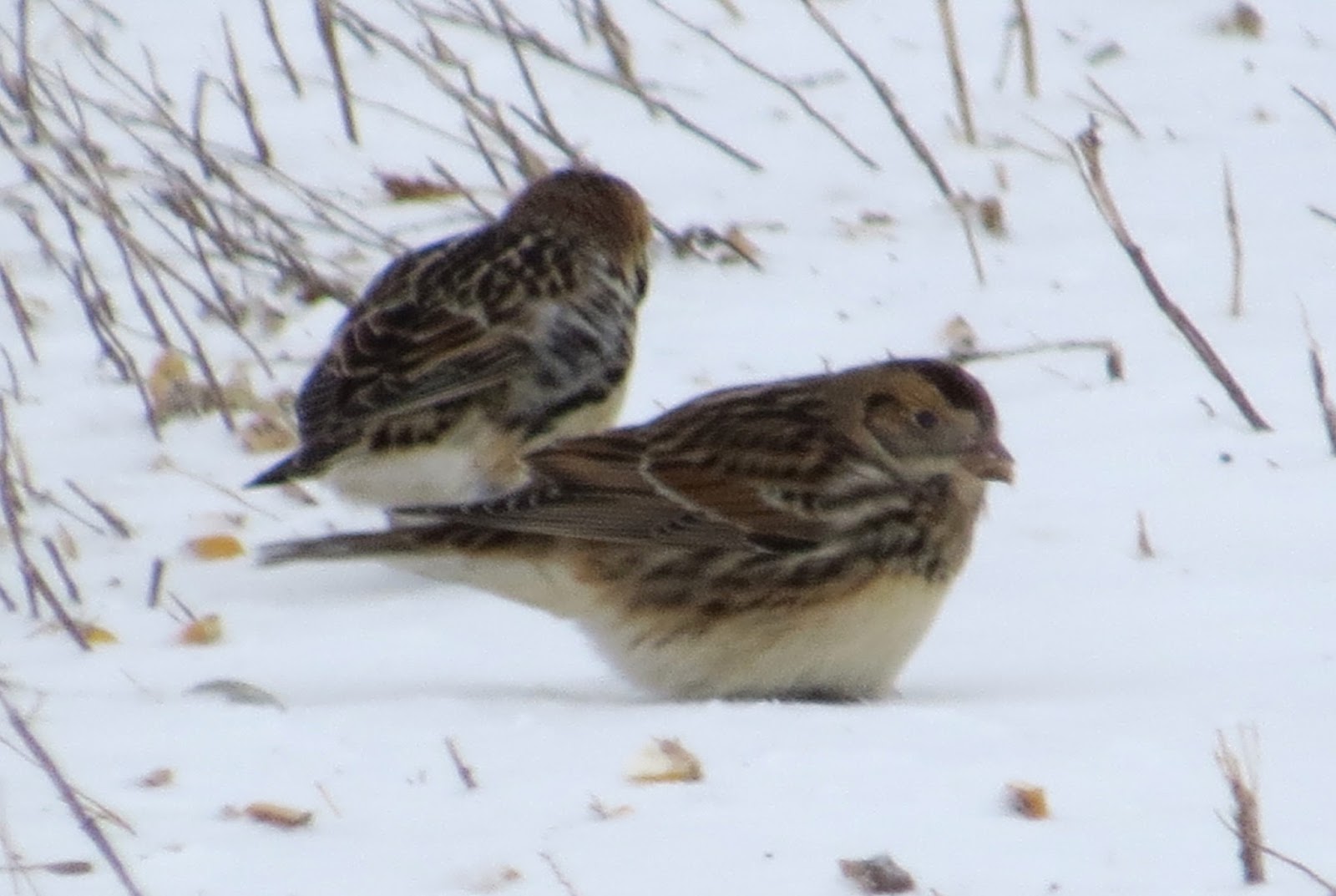
Lapland Longspurs


Horned Lark

Here's another shot of the rural landscape. I love the patterns of bare hedgerow and grasses against the snow.


Though we had a slow start to winter this year, strong cold in the past week caused ponds and streams to ice up quickly. The large pond south of Superior Drive in Northfield had just a few open areas of water left, and in one of them we saw two Canada geese, a mallard, and two American coots. The coots were a surprise, as they don't generally winter here, but perhaps they were lulled by the extended fall we had until recently.

American Coots (rear and right) with Canada Geese

I was also excited to identify a rough-legged hawk -- another Arctic-breeding bird that winters in southern Canada and much of the U.S. The prominent black patches at the bend of the wings helped identify this rather pale hawk.

Here's our full list for the day:
  • Canada Goose - 19
  • Mallard - 100+ - seen all at once, criss-crossing the sky in many skeins, wings beating fast
  • Rock Pigeon 5
  • Mourning Dove 3
  • Bald Eagle 6  - including a group of 5 circling together, 3 adults and two juveniles
  • Red-tailed Hawk - 1
  • Rough-legged Hawk - 1 
  • Red-bellied Woodpecker - 4
  • Downy Woodpecker - 7
  • Blue Jay - 1
  • American Crow - 14
  • Horned Lark - 2
  • Black-capped Chickadee - 11
  • White-breasted Nuthatch - 4
  • American Robin - 1
  • Cedar Waxwing - 20
  • House Sparrow - 20
  • House Finch - 10 (I wonder if I captured them all -- it might have been a few more)
  • American Goldfinch - 2
  • Lapland Longspur - 2
  • Snow Bunting - 2
  • American Tree Sparrow - 4
  • Dark-eyed Junco 30
  • Northern Cardinal - 6
No starlings, pheasants or turkeys!

Sunday, January 17, 2016

Watching Birds on Winter's Coldest Morning

It was about -15 F. when I spent some time watching birds at our feeders and in nearby trees this morning. Our coldest days tend to be cloud-free, so the light was good. Since I take many of my feeder photos through my living room window, I do some color correcting afterward to take away the dullness that the window and its glare can impart.


I love female cardinals. This one's red eyebrow is illuminated, matching her beautiful red bill. She's accompanied at the feeder by a goldfinch and, barely visible, a house finch.


This female white-breasted nuthatch caught my eye because, unusually, she was head-up on the trunk of our big maple tree, rather than upside down as one usually sees nuthatches. She's well-fluffed for maximum insulation from the cold.


This male house finch is also doing a puffball imitation to keep warm.


And this bright-eyed chickadee sat in the same position for quite a while. Was he or she miserable in the cold, or doing just fine? Our northern birds seem to handle the cold remarkably well, Here is a good overview from the Cornell Lab of Ornithology of some of the ways birds cope with severe cold, which include not only fluffing up those down feathers but eating as much as possible and sheltering from the wind.

Sunday, December 21, 2014

Christmas Bird Count 2014: Quiet

Participating in the annual Christmas Bird Count has become a tradition I look forward to eagerly. It's a chance to devote half a day, or more, to looking for birds and documenting the number of each species we see, as well as our time spent and mileage covered by car and on foot, to aid in interpreting the numbers reported. I've also written here about the Christmas Bird Counts of 2009, 2010, 2011, and 2013. As in the past, we were assigned to a rural area east and south of Northfield, as well as a good portion of Northfield's east side.

Relatively mild at about 30-32 F. all morning, it was also gray and chillingly damp, though thankfully not windy. Ponds were frozen, while creeks were open. The mantra of the day for our group of four turned out to be, "Boy, it's really quiet out there." While we saw some decent action at a few homesteads that had well-stocked feeders, we came up dry at many others, including those at my own house. It wasn't always literally quiet, as we had an ample number of crows cawing raucously, but there were a lot of places that seemed unexpectedly bird-free.

Open water at the creek west of Dennison -- but no birds

The photo above is taken from the highway bridge just west of Dennison. Every year I get my hopes up for this creek, which often offers open water and seems so inviting from a human perspective, but once again there was nothing to see.

Here are our results for the morning. Occasionally birds (mostly chickadees and nuthatches) were identified by sound though not seen.

  • 2 Canada geese
  • 55 mallards, seen in many small groups overhead, flying with their characteristic rapid wingbeats, and in a large congregation on the open creek in the golf course
  • 1 ring-necked pheasant. Pheasant numbers are down so much in the last few years that this was now considered a lucky sighting.
  • 1 sharp-shinned hawk seen flying through woods (I missed seeing this. Darn!)
  • 1 red-tailed hawk
  • 19 rock pigeons (your standard barnyard or urban pigeon) on silos
  • 5 mourning doves
  • 1 red-bellied woodpecker
  • 5 downy woodpeckers
  • 1 hairy woodpecker
  • 12 blue jays
  • 52 American crows
  • 14 black-capped chickadees
  • 7 white-breasted nuthatches
  • 43 dark-eyed juncos, including a flock of 35 seen on the west edge of the Sibley School natural area
  • 5 northern cardinals
  • 39 house finches, the majority of them in one large group at a rural homestead with plenty of large trees and well-stocked feeders
  • 22 house sparrows, mostly in one large group at the pond west of Archibald Street and just north of Jefferson Parkway; we first caught sight of a few of them on top of and going into a wood duck box. 
This total of 18 species is the same as our total in 2011 (the last count I can find detailed notes for). Species seen then that we did not see yesterday included the European starling, wild turkey, American robin, American goldfinch, and northern shrike. Species seen yesterday that we did not see in 2011 included Canada goose, ring-necked pheasant, sharp-shinned hawk, rock pigeon, and hairy woodpecker. I always hope to see snow buntings or horned larks for the CBC, but there were none to be seen yesterday, nor (ambitious hope) a snowy owl, for which there have been sightings in Rice County in the past week or so.

Non-avian sightings included plenty of squirrels and, notably, a mink that was being eyed warily by a pair of mallards on Spring Creek on the east edge of Northfield.

I was happy to see several new participants at our Northfield-based count, including my longtime friend Mary, who came along in our group, as well as the now-familiar friends who are faithful to this effort. Thanks as always to Gene Bauer for organizing the bird count for the Northfield area, Gene and his wife Susan for their hospitality for the pre-count breakfast and post-count lunch, and the other bird enthusiasts, both experienced and developing, who showed up and helped make it a fun day of comradery and citizen science.

Sunday, November 2, 2014

Leaf-fall and Autumn Birdwatching

We have a large, beautiful maple tree in front of our house, which makes a nice staging point for birds coming to our feeders. In the summer, we may hear the birds in the tree, but we don't see them until they leave the thick leafy cover. In the fall, for a week or two the tree is gloriously golden-pink, and then, of course, the leaves fall. My sadness at losing the color is never long-lived, because as the leaves drop, the birds become visible in the tree once more and I know we have entered one of our most satisfying birdwatching seasons. Our summer birds have departed, the goldfinches have put on their winter plumage, the dark-eyed juncos have arrived for the season, and we are ready to hunker down by the living room window, camera and binoculars at hand, to see what we will see.

Our maple on October 17

Downy Woodpecker with backdrop of golden leaves, October 17

What we lose in leafy loveliness, we'll gain in bird visibility.
October 24

Winter-plumage American Goldfinch

This female Red-bellied Woodpecker has become a regular visitor
to the peanut feeder as the light starts to fade each recent evening. When she
leaves the feeder, I can see her moving higher and higher in the maple tree.

The coiled whole-peanut feeder caught some falling leaves.

Wednesday, December 11, 2013

Frosty Birdbath with Goldfinches

During some of our recent bitterly cold days, the edge of our heated birdbath developed a thick rim of frost. The birds have been flocking to the feeders and appreciate the chance to sip some liquid water from the birdbath. In this series, a bright-eyed American goldfinch in winter plumage took a drink and was joined by others. (As always, click on the images to see a much larger version.)


Wednesday, October 2, 2013

Transitional Goldfinch

It's the time of year when the male American goldfinch loses his lemon-yellow breeding plumage and takes on his drab winter colors. Here are a couple of photos of a transitional goldfinch at one of our feeders this past week. Kind of a mess, isn't he?


For comparison, here is what a male goldfinch looks like during the breeding season (spring and summer):


And here is a winter goldfinch (this may be a female, as a winter male may have more yellow on his head, but they are not terribly different from each other):


I've written about goldfinches several times: see other posts here.

Sunday, November 11, 2012

24 Pine Siskins!

This weekend Project Feederwatch got started for the season (it runs November to April), and there has been plenty to see. A cold, wet front came through last night, taking us from a record-breaking high of 69 F (official Twin Cities temperature; several sources showed it to be even warmer than that here in Northfield) yesterday afternoon to the upper 50s at midnight to the upper 20s currently. Perhaps as a result of this change in the weather, there was a great deal of activity at our feeders today -- but actually we've had plenty of activity anyway, recently.

However, today there was one noteworthy appearance. In addition to house finches, chickadees, a downy woodpecker, blue jays, dark eyed juncos, and both white-breasted and red-breasted nuthatches, we've had quite an invasion of pine siskins. These are small, streaky finches that are cold-season-only birds for us here in southern Minnesota when they are here at all -- depending on the availability of their preferred seed crops, they may be present in large numbers one winter and barely seen another winter. 

We'd been seeing a couple occasionally for several weeks and then a few days ago Dave counted 14 while I was at work. Today we had at least 24 at the house. I saw many, many in the big maple tree out front (the staging area from which many of our visiting birds approach our feeders), then went over to the small window from which I can take a close look at the feeders they prefer, and at that point (no longer being able to see if some were still in the tree) I counted a dozen on the ground, seven in the caged feeder and five on the sock feeder.

In the photo below, one goldfinch in winter plumage keeps company with four pine siskins. Goldfinches and pine siskins are very similar in size and body style, with small, sharp beaks, but the goldfinches have a clear breast (nicely displayed below) while the siskins are heavily streaked all over.

Goldfinch (center left) and pine siskins

In our four years of feeding birds at this location, and two prior years of keeping nearly weekly count of what we see during Project Feederwatch, this was by far the largest number of one species we've seen at a single time. I think 14 house finches was the highest count we've had before.

Seven (visible) pine siskins

It's been many weeks since my last post here. As I was looking back to see what photos I had taken since the end of summer, I came across this shot of goldfinches at the sock feeder in mid-September. These males were looking a little patchy as they were changing from their brilliant lemon-yellow summer plumage to their more sedate winter plumage (as seen in the top photo above).

Moulting goldfinches in mid-September

Our summer birds have mostly left us by now, and I wonder what kind of winter we have ahead of us. We've had nearly nine months of no winter, since our amazing early warm spell last March (nine months of no winter may be normal many places, but not in Minnesota!), and the winter that came before that was exceptionally mild. I feel ready for the "indoor season" to begin. But I know it's not indoor season for the birds that stay, and they've got hardships ahead. We'll keep our feeders full to help them see it through.

Sunday, November 20, 2011

Pine Siskins and Snow - First of the Season

We had a wonderful turnout at the feeders today, after it sleeted and snowed much of the day yesterday -- the first snow that has "stuck" here in south-central Minnesota this season. During the lunch rush, I noticed some familiar figures I hadn't seen since May: three pine siskins. Last year we first noticed them on December 5.

Pine siskin (above) and white-breasted nuthatch

Similar in size and body style to an American goldfinch (and listed next to it in the various field guides), the pine siskin has a heavily streaked underside, a sharp, narrow beak, a notched tail, and a yellowish tinge to its wings.

Two pine siskins


The photos above and below, caught while I was using my camera's rapid-burst mode, crack me up -- it appears that this little guy does not need to use his or her wings to fly.


Sunday, November 13, 2011

Project FeederWatch

This was the kickoff weekend for the 2011-2012 Project FeederWatch season. Project FeederWatch is a citizen science project of the Cornell Lab of Ornithology and Bird Studies Canada that invites people to track the birds that visit their feeders from November to April (the nonbreeding season). Over a two-day period each week, you watch when you can and note the species seen, as well as the largest number of each species seen at once. It's not too late to sign up -- last year we didn't get going until at least January. I'm excited to track our visitors for the whole period this time.

Blue jay at wreath feeder
(photo taken last summer)
Having been hit by a bad cold at the end of the week, it was a perfect weekend to spend a lot of time in a living room chair with a book, looking out frequently between nose-blows to see if there was any action at the feeders. Yesterday was fairly quiet, but today we put out some additional food and we had a lot of visitors, by our standards:
  • American Goldfinch (3)
  • Black-capped Chickadee (3)
  • Blue Jay (4)
  • Dark-eyed Junco (5)
  • Downy Woodpecker (1)
  • House Finch (8)
  • Northern Cardinal (1)
  • Red-bellied Woodpecker (1)
  • White-breasted Nuthatch (1)
Red-bellied woodpecker
(photo taken last winter)
The blue jays put on a lovely show for us when I put out some whole (in-shell) peanuts for them. They cleaned out the four or five handfuls of peanuts in a couple of hours. We've learned not to fill our wreath-style peanut feeder, because they'll polish off the lot in less than a day, so we only fill it about a quarter full at a time, typically. 

The red-bellied woodpecker was an unexpected treat for the start of the season. I've written in the past about not seeing them often, and mainly in deep cold spells, though we did start to see one a bit more often last year.

Wednesday, March 2, 2011

Pine Siskins on Seedheads

I've been very glad I left our purple coneflower seedheads uncut for proverbial "winter interest" this year. Not only have they provided a welcome visual variation from the snow-covered ground, but birds that like narrow seeds, including the goldfinch and the pine siskin (the bird shown below), have taken advantage of them from time to time throughout the winter, even though only a few feet away there is a mesh sock-style feeder full of Nyger thistle seed that's surely easier to cling to than these swaying stems.


Wednesday, September 29, 2010

Goldfinch, Pausing

Goldfinches and other birds often land on the shepherd's crook that supports one of our feeders, but they don't usually stay long enough for me to get a photo. This goldfinch paused just long enough for me to capture the moment. I like the pensive look and the little pink feet.

Tuesday, September 21, 2010

Birds Small and Large


I couldn't help contrasting these two photos: the dainty little goldfinch above and the hulking great blue jay below that stopped by for a brief munch. I don't normally think of blue jays as being all that big, but in comparison to the songbird this one looks huge.

Tuesday, May 18, 2010

And Here's the Male (Goldfinch, That Is)

A couple of days ago I was able to get some shots of a female goldfinch at our thistle feeder, but the male ducked behind the feeder and I couldn't get good shots of him. This morning they were both there again, this time with the female at the tube-style feeder and the male in plain view at the thistle-seed sock. I like this sequence, which shows not only the bright yellow of the male's breeding plumage and the handsome black and white of the wing and tail feathers but also the pointy shape of the little black cap on his head.


Sunday, May 16, 2010

Goldfinch at Thistle Feeder


This female goldfinch came to the feeder with her mate this morning. These were the first goldfinches I'd seen in their breeding plumage this spring; we saw them over the winter a few times in their much more subdued winter plumage. The male, of course, is the true bright yellow, but he ducked behind the feeder so I couldn't get a good shot of him through the window. This photo was a nice use of the powerful zoom on my new camera. When a small subject like this is not too far away, it seems to work well.

Posted by Picasa

Tuesday, October 27, 2009

Feeder Birds, Late October

A pair of cardinals were trying to get at the seed on the floor of the caged feeder a few days ago. Cardinals want their seed served on a flat surface, not from a hanging feeder. We're going to look into some kind of platform feeder, perhaps placed right outside the living room window. Above is the male, resting on top of the caged feeder.


Above is a goldfinch in winter plumage - not gold at all, as you can see:
Adult males in spring and early summer are bright yellow with black forehead, black wings with white markings, and white patches both above and beneath the tail. Adult females are duller yellow beneath, olive above. Winter birds are drab, unstreaked brown, with blackish wings and two pale wingbars.
-All About Birds - Cornell Lab of Ornithology

It took a while for the goldfinches to find our thistle-seed feeder after we put it up in late summer, but they are regular visitors now. Our other regulars include plenty of chickadees and some house finches.

Tuesday, February 17, 2009

Failed Backyard Bird Counter

The 12th annual Great Backyard Bird Count weekend (Feb. 13-16) has come and gone, and I utterly failed to count anything. The task was to watch for birds for at least 15 minutes and to track the greatest number of each species seen at the same time. The trouble is that most of our avian visitors come at their morning and evening feeding times, and not always then. And family life is busy and distracting, and I kept forgetting to look out at the most appropriate times. On Sunday afternoon I did remember, printed out the local species list from the GBBC website, announced, "Okay, I'm really doing this now," and saw nothing but three gray squirrels -- which were not on the list.

I would have liked to try to count the individuals in a large flock of crows that occasionally comes through in the early evening, filling the treetops with their dark bodies and the air with their raucous caws. I would have liked to count the chickadees and house finches that are the most frequent visitors to our feeders. I would have loved to see a white-breasted nuthatch or a downy or red-bellied woodpecker or dark-eyed juncoes or overwintering robins or a goldfinch or a cardinal. A real treat would have been to see redpolls, which only visit this far south during occasional winter irruptions but have been spotted in the Twin Cities recently. Oh well. Maybe next year. Meanwhile, I'll enjoy seeing any of these birds when I next have the opportunity, even if they don't officially "count."

Thursday, January 15, 2009

Birds Flock to Feeders

My resident bird expert called me at work today at about noon (he was at home with a car that wouldn't start because of the cold) to let me know that droves of birds were appearing at our feeders, which as of last weekend finally include a suet feeder to supplement our two seed feeders. We haven't seen a lot of action at the feeders recently, despite the cold, and the seed levels have hardly budged. Today, after our frigidly cold night reported by weather.com as -24 F., birds were clearly looking for the calories needed to sustain life.

Dave excitedly reported seeing a downy woodpecker, the first bird either of us had noted at the suet feeder since putting it up on Sunday, as well as chickadees and a combined flock of American goldfinches and pine siskins (closely related birds, but easily distinguishable by the streaky breasts of the siskins) .

I arrived home for lunch shortly thereafter, and we were almost immediately treated to the arrival of a red-bellied woodpecker at the suet feeder (below).

These are gorgeous birds, much bigger than anything else that has visited the feeders, and I have never seen one nearly so close before. It was truly a breath-taking sight. (Red-bellied woodpeckers would doubtless be known as red-headed woodpeckers were it not for the complete red hood of the bird that already bears that name.)

Below, a chickadee digs for a seed in the cage feeder, designed to protect smaller birds while feeding.

Below, a male goldfinch in winter plumage is seen with a seed in its bill.

I had never seen goldfinches in winter before; I just learned last spring that goldfinches can be seen year-round in this region, but the bird I saw last spring was already in its bright lemon-yellow breeding plumage. Here, you can see the handsome black and white flight feathers that remain year-round against a soft- gray-fading-to-tawny back and breast, with a yellow patch faintly visible under the chin.

Below, a bright red male house finch has joined what I believe are a male and female goldfinch, with the male on the left showing the distinct yellow chin-patch and slightly more marked color contrasts than his more subtly colored mate.


Posted by Picasa